Subscribe to newsletter
Subscribe to our newsletter and get updates on the newest posts we release.
By subscribing you agree to our Privacy Policy


You want a spare car key. The hardware store quotes you three dollars. The dealer quotes you two hundred and eighty and wants the car towed in. Same car, same key, and nobody says why one number is so much bigger. One word keeps coming up: transponder. So you are being asked to pay for a part you cannot see and nobody has described. Does my car even have one? Am I being upsold?
I have cut car keys for years, and this is my most common call. Here is the plain version.
A transponder key is a car key with a small chip sealed in the plastic head. The chip has no battery. Bring the key near the ignition and the car powers that chip, reads the code it sends back, and only then lets the engine keep running.
The metal opens your door and turns the ignition. The chip is what lets the car start.
Cut the metal but skip the chip, and the engine cranks, catches for a second, then dies.
A copy runs about $60 to $250. The chip sets that price, not the car.
You cannot tell which chip you have by looking at the key.
That last one is why two neighbors with the same car get very different quotes. Under 49 CFR 571.114, a car key is "a physical device or an electronic code," so the code counts as much as the metal. Our guide to where you can get a car key made covers your options, and the key fob programming walkthrough covers the button side. By the end you will know what the chip does, how to tell if your car has one, why the "every car after 2000 has a chip" rule is wrong, what a copy should cost, and the five questions to ask before you pay.
Key takeaways
The chip has no battery. Your car powers it and reads it at every start.
No federal rule ever required chips in American cars. Canada required them in 2007.
Some chips get copied off your working key in minutes. Others must be written into the car.
Copying needs no security code from the carmaker. Writing one in usually does, and the price jumps.
While you still hold one working key, a second one is the cheapest it will ever be.
What the chip does when you turn the key
Here is the part that helps you spot a bad quote.
Around your ignition, or behind your start button, sits a ring of wire. Bring the key close and it sends out a short burst of radio energy. The chip soaks up enough to wake up, then answers with its code. Your car checks that code against the ones it stored. Match, and fuel and spark stay on. No match, and the car kills the engine in a second or two.
So a key with no chip is not broken. Your car just refuses to accept it.
How to tell if your car has one
The first three checks need no tools.
Look at the head of the key. A chip key has a fat plastic head, about half an inch thick, with no seam to pry open. A plain key is thin metal all the way up.
Try the crank test. Use a cut key that will not start the car. Turn it. If the engine spins, fires for a second, then quits, the chip check just failed. Neither a dead battery nor a bad starter acts like that.
Watch the dashboard. Many cars show a small key symbol, or a car with a padlock in it. If it blinks while the car will not start, the car did not know the key.
Have the part number read. This is the only sure check. A locksmith reads the blank's part number or scans the key. Two keys can look the same and hold different chips.
I would not trust the model year on its own. The next section is why.
Does every car built after 2000 have a chip?
No, and most articles get this wrong.
The United States never required a chip. The federal theft rule, FMVSS 114, asks only two things. The car must not start with the key out. And the carmaker must offer at least 1,000 key combinations per vehicle type. Read the whole rule and the word immobilizer never shows up. Chips went in because carmakers chose to add them.
Canada went the other way. Transport Canada required an immobilizer on every new passenger vehicle sold there from September 1, 2007, and reports thefts falling by about half after that.
You can see what the American choice cost. The Insurance Institute for Highway Safety reported in September 2022 that in model year 2015, immobilizers were standard on 96 percent of other carmakers' vehicles, but on only 26 percent of Hyundai and Kia models. That is fifteen years past 2000, with three of four built with no chip.
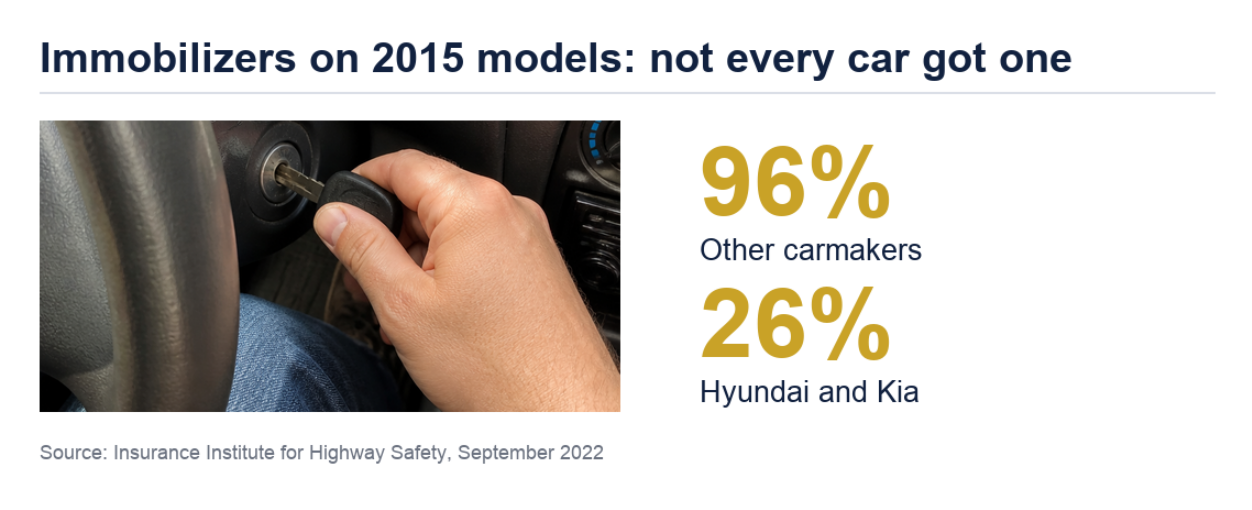
Immobilizers were far from universal on 2015 models. Source: Insurance Institute for Highway Safety, September 2022.
So if a shop prices your chip off your model year alone, they are guessing, and you may pay for work your car does not need.
Why one chip key costs $60 and another costs $250
Two jobs share a name and are not the same work.
Cloning copies the code off your working key onto a new chip. Locksmith Ledger, a trade journal for locksmiths, says plainly that "vehicle PIN codes are not needed to clone a key." Your car never has to know. It is quick and cheap.
Programming writes a new key into the car's computer. The same journal notes that fixed value chips are built for "on-board programming" through the car's diagnostic port. So the car has to be there, and the shop often needs a security code from the carmaker.
Which one you get is not your choice. Locksmith Ledger is blunt: whether a chip can be cloned "cannot be determined visually." Only the part number tells you. The key in your pocket set your price before you called anyone.
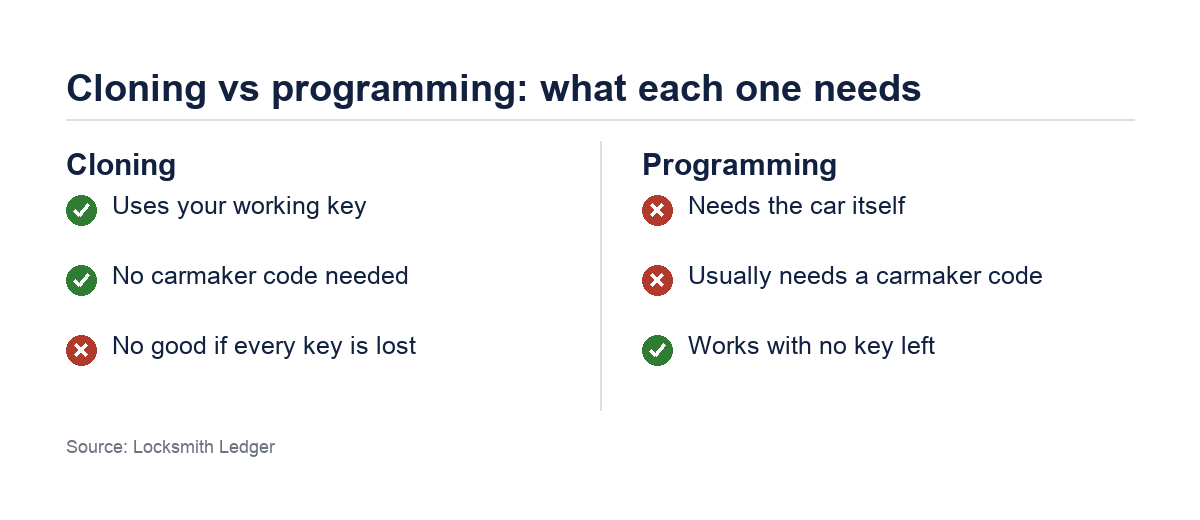
What each job needs. Source: Locksmith Ledger.
Roughly what people pay in 2026, as national ballpark ranges:
What you have | What the shop has to do | Typical range |
|---|---|---|
Look at the bottom row against the middle two. That is the case for making a spare while your key still works, as our car key replacement guide also argues.
Five questions to ask before you pay
These are the words to say.
"Is my key cloneable, or does it have to be programmed?" A shop that answers has looked up your car. One that cannot will find out at your expense.
"Do you need my car there, or just my working key?" Cloning often needs only the key. If they want the car for a job you were told was a copy, ask what changed.
"Does that price include cutting, the chip, and the programming?" Get one number for a finished key that starts the car.
"What if it does not start when you are done?" You want to hear they stay until it works, at no extra charge.
"What do you need to prove the car is mine?" An honest shop asks for your license and registration. If nobody asks, that is a red flag, and our guide to spotting a fake locksmith covers the rest.
One thing worth watching this fall
A bill could change who may program your key. The Motor Vehicle Modernization Act of 2026, H.R. 7389, was voted out of the House Energy and Commerce Committee 48 to 1 on May 21, 2026, per the official bill record. It carries right to repair language about the data independent shops can get. It has not passed the House, has not reached the Senate, and is not law.
Watch it because most cars are old now. S&P Global Mobility reported on May 21, 2025 that the average American vehicle hit a record 12.8 years. Cars that old are the ones needing a second key, and nobody can name their chip on sight.
Frequently asked questions
Can I borrow a key from another car of the same make and model?
No. Two identical cars off the same line hold different codes, which is the point of that 1,000 combination rule. A borrowed key may turn in your door, but the car will not take the chip.
Will my transponder key work if the car battery is dead?
The key is fine, since it has no battery to go flat. The car is the problem. With no power, that ring of wire cannot wake the chip. Jump the car and the key works again.
Can I buy a key online and have someone program it?
Often yes, and it can save money, but check the part number against your car first. A blank with the wrong chip cannot be made to work.
Can the chip get damaged?
It can. The chip is glass or plastic, and it does not survive concrete or a wash cycle. A key that used to start the car and now cranks and dies, with the metal undamaged, is often a cracked chip.
Need a spare chip key made?
Keyzoo cuts and programs transponder keys across eleven states, at your car or at one of our key kiosks. We will tell you on the phone whether yours is a clone job or a programming job before you commit.