Subscribe to newsletter
Subscribe to our newsletter and get updates on the newest posts we release.
By subscribing you agree to our Privacy Policy


A lockout is the perfect setup for a scam. You are stressed, you are in a hurry, and you grab the first number that shows up in search. That urgency is exactly what fraudulent locksmiths count on. Knowing how to avoid locksmith scams comes down to a handful of fast checks you can run before anyone arrives at your door, even while you are standing outside in the cold.
This guide breaks down how the modern scam actually operates, the red flags that give it away, the steps to confirm a real and licensed local locksmith, what to do at the door if something feels off, and how to report a scam if you get caught by one.
How the modern locksmith scam works
The locksmith scam is not random opportunism. It is an organized model designed to flood your search results and quietly intercept your call. Operators create large numbers of fake business listings, often under generic names like “24/7 Locksmith” or “Locksmith Near Me,” and pad them with fake reviews so they look established.
Increasingly, those listings are backed by AI-generated websites that look polished and local but describe a business that does not physically exist. A growing tactic is hijacking the phone number on a real, long-standing listing, so a call you believe is going to a neighborhood shop is silently rerouted to an out-of-state call center.
Once you call, a dispatcher quotes a low number to win the job. The technician who shows up, often an undertrained subcontractor, then inflates the bill on site. They may claim your lock is “high security” or insist it has to be drilled out and replaced, then pressure you to pay before you get your keys or access back. That switch from the quoted price to a much larger on-site charge is the bait-and-switch at the center of the scam.
This is not a fringe issue. In 2025, Google announced it had removed more than 10,000 fraudulent listings tied to people impersonating real locksmiths, and it filed a lawsuit against the operators behind them. Consumer-protection groups and local outlets have continued issuing fresh warnings into 2026. If you do find yourself locked out, working with a transparent provider such as Keyzoo’s 24/7 emergency locksmith service removes the guesswork the scam depends on.
The red flags to watch for
Most scams give themselves away if you know what to look for. Watch for these signals before you commit to anyone:
No local address, or an 800-number only. A legitimate locksmith can be mobile without a storefront, but they will still have a verifiable local address or a local phone number. A toll-free number as the only point of contact for a supposedly local business often points to a national lead-generation operation, not someone in your area.
Vague pricing and a refusal to put anything in writing. Insist on a clear, all-inclusive written estimate before any work begins. If a dispatcher dodges the question or will not confirm details in writing, treat that as a warning. A suspiciously low advertised price followed by “and up” is a classic hook designed to get you to commit before the real bill appears.
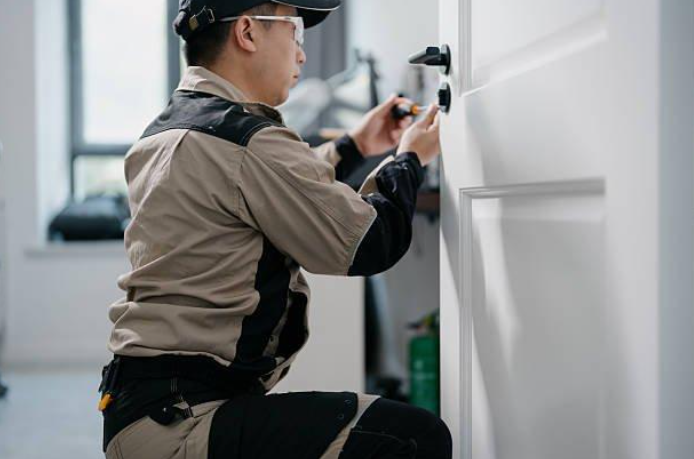
An unmarked vehicle and no uniform. Real locksmiths typically arrive in a branded vehicle and wear a uniform, name tag, or logo. An unmarked van and plain clothes are common with subcontracted scam jobs.
No license where one is required. Licensing requirements vary by state and city. In places that require it, a real locksmith can show a state-issued license or ID. An excuse for why they cannot is a red flag.
A “ghost” storefront. Drop the listed address into a map and check Street View. If the “office” is actually a bodega, an apartment lobby, a mailbox store, or an empty lot, the listing is almost certainly fake.
How to avoid locksmith scams: verify a legitimate locksmith before they arrive
A real locksmith is easy to verify in under a minute. Run these checks before you say yes:
Confirm a real local address. Look up the business on a map and confirm the address is a genuine commercial or service location, not a residential lobby or mailbox.
Check licensing and credentials. Ask whether they are licensed in your state and request the license number if your area requires one. Industry directories such as the ALOA member finder at FindALocksmith.com only list vetted, background-checked locksmiths, which makes them a useful cross-reference.
Check that the name and phone number stay consistent. The company name that answers the phone should match the listing, the website, and the vehicle that arrives. The same phone number should appear across the listing, the site, and the reviews. Mismatches are a sign the listing has been hijacked.
Read the actual reviews, not just the star rating. Look past the average score and read the text. Repeated mentions of surprise charges, aggressive upselling, or unexpected drilling are warnings even when the overall rating looks high. A sudden burst of near-identical five-star reviews is its own red flag.
The strongest move is to save a trusted local locksmith in your phone before you ever need one. Keep a reliable provider for car lockouts and home and residential service stored now, so a future lockout is a known quantity instead of a frantic search.
What to do at the door and if something feels off
Verification does not stop when the technician arrives. A few checks at the door protect you from the on-site switch:
Match the name. Confirm the company name on the vehicle and uniform matches the business you actually called. Ask for a business card and, in licensing states, the technician’s state-issued ID.
Get the all-inclusive price in writing before work starts. A real locksmith will confirm the full cost up front. If the number jumps the moment they look at the lock, stop.
Be skeptical of immediate drilling. Most standard lockouts can be opened without destroying the lock. A technician who reaches for a drill on an ordinary lock right away is often setting up an inflated replacement charge.
You can say no. If you feel pressured or unsafe, you are allowed to decline the work and send them away before anything is done. Do not hand over keys or payment under pressure.
Pay by card when you can. A card payment creates a record and gives you the option to dispute a fraudulent charge later.
How to report a scam
If you have been overcharged, threatened, or had property damaged, reporting it helps protect the next person and can support enforcement against repeat operators:
Local police. Contact them if you were threatened, intimidated, or your property was damaged, or if a technician refused to leave.
Your state consumer affairs office or attorney general. Most states have a consumer protection division that investigates patterns of deceptive business practices. Repeat complaints against the same operator raise enforcement priority.
The FTC. File a federal report at reportfraud.ftc.gov. The FTC has pursued national locksmith lead-generation networks before, and your report adds to that record.
Your card issuer and a public review. Dispute the charge with your bank or card company, and leave an honest, factual review describing what happened so others can avoid the same operator.
Bottom line
The best defense against a fake locksmith is a few seconds of verification and a trusted number saved before you need it. Confirm the address, the licensing, the consistent name and phone, and the written price, and you remove almost everything the scam relies on.
Questions before you book? Contact Keyzoo.