Subscribe to newsletter
Subscribe to our newsletter and get updates on the newest posts we release.
By subscribing you agree to our Privacy Policy


You are at your own front door with groceries in one hand. The key is in the deadbolt and it will not turn. Or the thumbturn spins and the bolt never moves. Either way you have three questions at once: did I break my lock, am I about to be shut out of my house, and what does this cost? Most stuck deadbolts I get called to are a five minute fix, and some you can handle before you call a lock repair tech. The rest usually need a rekey, not a new door.
A deadbolt stuck in the locked position is almost always one of two things. Either the door has shifted and is pinching the bolt inside its hole, or the inside of the lock is dirty, dry, or worn out.
Push the door into the frame with your shoulder while you turn the key. If it turns then, the door is your problem.
A key that goes in and stops halfway is a worn lock or a worn key.
A thumbturn that spins with no resistance means a part inside has snapped.
Screws driven in too tight can squeeze the lock until nothing turns.
Kwikset says much the same in its own latch troubleshooting notes. The hole behind the strike has to be at least one inch deep. The bolt has to land in that hole instead of hitting the strike or the frame. By the end you will know the ten second test that sorts the door from the lock, which of the six causes fits your lock, what belongs in the keyway, and what this costs.
Key takeaways
The door and the lock fail in different ways. One push on the door tells you which one you have.
A key that turns partway and stops is worn or dirty inside. Force never fixes that.
Loosening the two mounting screws a half turn is a real repair, and door makers publish it.
Oil spray and graphite are the first things people reach for and the two lock makers say to skip.
A cleaning or a rekey saves most of these locks, so you rarely need new hardware.
Start here: is it the lock, or is the door pinching the bolt?
Put your shoulder on the door, push it into the frame, and turn the key. If the key turns now, your lock is fine. The door has dropped or the frame has moved, so the bolt is jammed against the side of its hole. Your key was fighting the weight of the door.
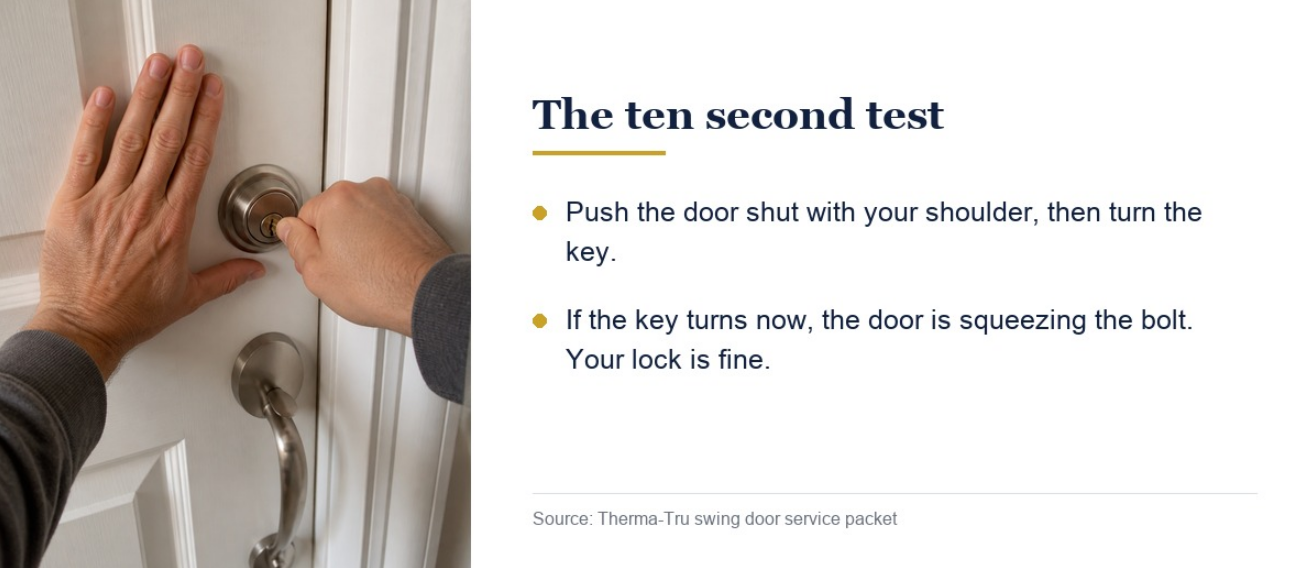
Therma-Tru puts this first in its swing door service packet: be certain the door is square in the frame before you adjust any other hardware.
Try lifting the door by the handle too. In an older house, one long screw through the top hinge into the framing pulls a sagging door back up, and the pinch goes away for good.
Match what your lock is doing to the cause
Find your symptom here, because each one points somewhere different.
What your lock is doing | What is usually causing it | What to do first |
|---|---|---|
Why your key turns partway and then stops
This is the one I see most, and it is a lock that has quietly worn out. Small brass pins inside ride over the cuts of your key every time you use it. After ten years both the pins and the key are a little rounder than they were. They stop lining up right at the point where the lock has to keep turning.
Here is the tell. Your oldest key works better than your newest one, because a copy of a copy is never cut quite as deep as the original. Try every key in the drawer before you decide the lock is dead.
Do not muscle it either. A key twisted hard in a stuck lock is how you end up with half a key inside and a much longer afternoon.
The screws cause this more often than you would think
Two screws hold the outside half of your deadbolt to the inside half. Drive them in too hard and the lock body gets squeezed, and the key will not spin.
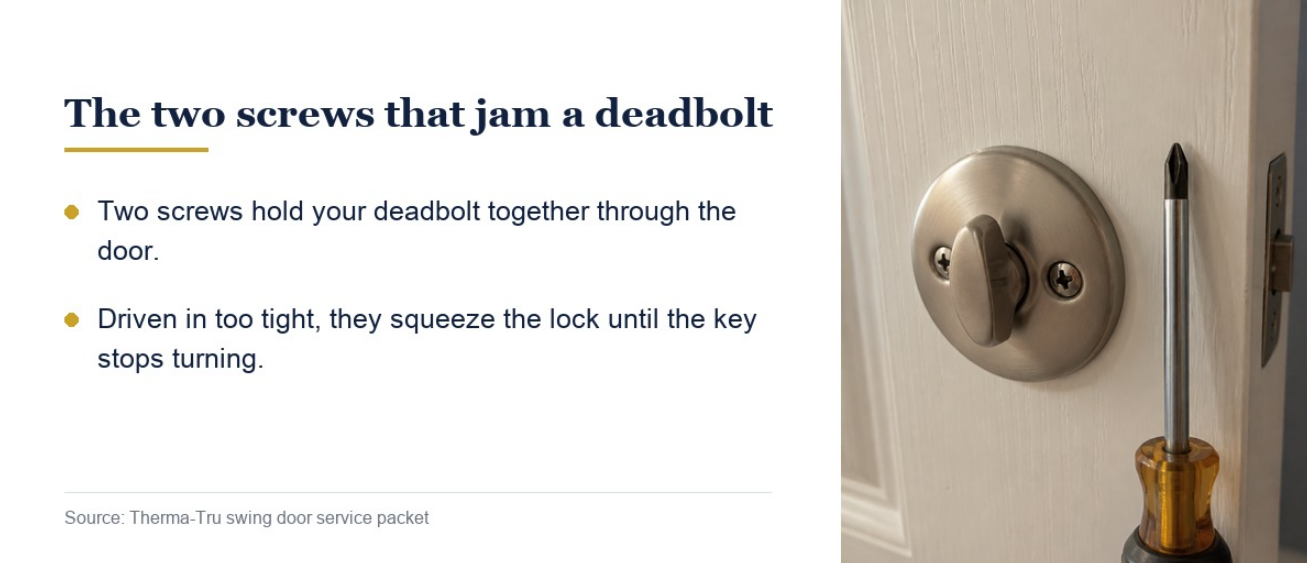
Therma-Tru lists the fix in that same service packet. Confirm the inside and outside holes line up with the lock case, then loosen the backplate screws a half turn. One screwdriver, thirty seconds. I have watched it save a lock somebody was ready to throw out.
What belongs in the keyway, and what does not
Almost every article on this tells you to puff graphite into the keyway. Master Lock's own maintenance page says the opposite. It tells you to use its PTFE lock lubricant, and then it adds, in plain words, never use dry graphite or a silicone lubricant.
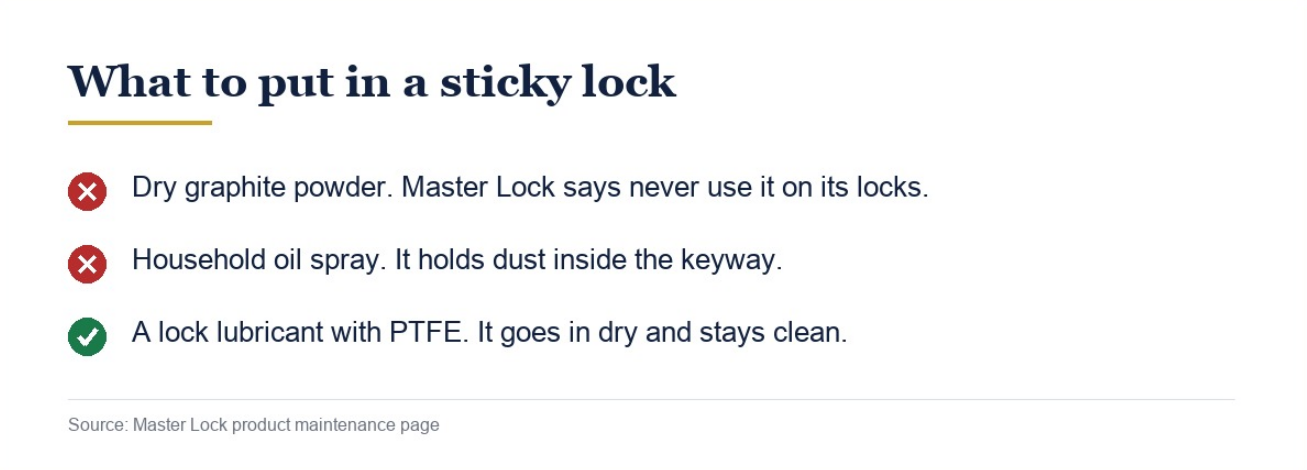
Skip the household oil spray too. Oil works for a day, then it holds dust inside the keyway, and the lock comes back stickier than it started. Use a lubricant made for locks. It goes in dry and leaves nothing for grit to stick to. Clean first and lubricate second. Spraying into a keyway full of pocket lint just glues the lint in place.
4 things I check before I quote a stuck deadbolt
Does the bolt move with the door open? I swing the door open and turn the thumbturn. A bolt that slides fine in open air and jams when the door is shut is a door job, not a lock job.
How does the key feel coming out? A key that drags on the way out tells me the lock is worn before I open it up.
Do all the keys work the same? If your original works and the store copy does not, I cut fresh keys and leave your deadbolt alone.
Does the bolt fill its hole? Kwikset asks for a hole at least one inch deep. A shallow or crooked hole means the bolt hits wood every time you lock up.
What a stuck deadbolt normally costs
These are typical national ranges. Your price moves with your city, the hour, and the hardware on your door.
The fix | Typical range |
|---|---|
Those last two rows are where people lose money. A sticking lock often needs a cleaning and fresh keys. Rekeying instead of replacing keeps a good deadbolt on your door. Keyzoo runs mobile locksmith service and self-service key kiosks in 11 states, so this is a call our techs take every day.
Frequently asked questions
Can a locksmith get me in if the deadbolt is stuck and I am outside?
Yes, and usually without harming the door. A tech picks the lock or pulls the cylinder to free the bolt. Drilling is the last resort.
Is it safe to grab the key with pliers and twist harder?
No. Pliers give you enough leverage to snap the key inside the lock, which turns a cleaning job into an extraction job. If the key will not turn under normal finger pressure, something is in the way.
Does a stuck deadbolt mean somebody tried to pick my lock?
Almost never. Picking leaves fine scratches inside, and it does not jam a bolt. A bolt that binds in its hole is a door that moved, which is wear and not a break-in.
Should I replace the deadbolt if this keeps happening?
Look at age and grade first. The 2025 edition of the residential deadbolt standard, ANSI/BHMA A156.40, runs a deadbolt through seventeen tests, and one loads the door against the bolt with 1,350 pounds of force. Hardware built to that is worth servicing. A thin lock on a twenty year old door is worth replacing.
How often should a deadbolt get serviced?
Once a year is plenty on most front doors. Wipe the bolt, check that the screws are snug and not cranked down, and give the keyway a shot of lock lubricant.
Stuck deadbolt right now?
A deadbolt that will not turn is no reason to take a door off its hinges, and no reason to stand outside guessing either. Tell us what your lock is doing and we will send a tech who carries the cylinders, pins and key blanks to fix it on the spot. Book Now at keyzoo.com/booking/zipcode.