Subscribe to newsletter
Subscribe to our newsletter and get updates on the newest posts we release.
By subscribing you agree to our Privacy Policy


How to Unlock a Door Without a Key: What Works on Each Kind of Lock
You need to unlock a door without a key, and you are standing in front of that door right now. Maybe your toddler pressed the button on the bathroom door and pulled it shut behind them, or a bedroom door swung shut with the button already pressed. What you want to know is which move actually opens this door.
It depends on the lock, not on the tool. How to unlock a door without a key starts with one look at the middle of the knob on your side. A small round hole or a flat slot means the lock was built so somebody could open it from the hallway. A keyhole, under a thicker lock you turn with a key or a thumb, means the opposite. That thicker one is the deadbolt, and it is built to stop every trick in this post.
By the end you will know which of the three locks you have, the move that opens an interior privacy lock, why a credit card does nothing to a front door, and what a locksmith does instead. I am Eli Itzhaki, and I write for Keyzoo, which runs mobile locksmiths and self-service key kiosks in eleven states. If it is your front door, our house lockout guide covers that call.
Key takeaways
A round pinhole in an interior door knob takes a straightened paperclip pushed straight in until it clicks, and the lock pops open in seconds.
A flat slot on an interior door lock is a turn release instead, so it takes a coin or a small flathead screwdriver turned a quarter turn.
A credit card does nothing on almost any front door, because a second small plunger beside the latch blocks the main bolt the moment the door shuts.
Drilling your own door lock costs you the lock and a key for every other door that matched it, and a locksmith opens the same door undamaged.
How to unlock a door without a key starts at the knob
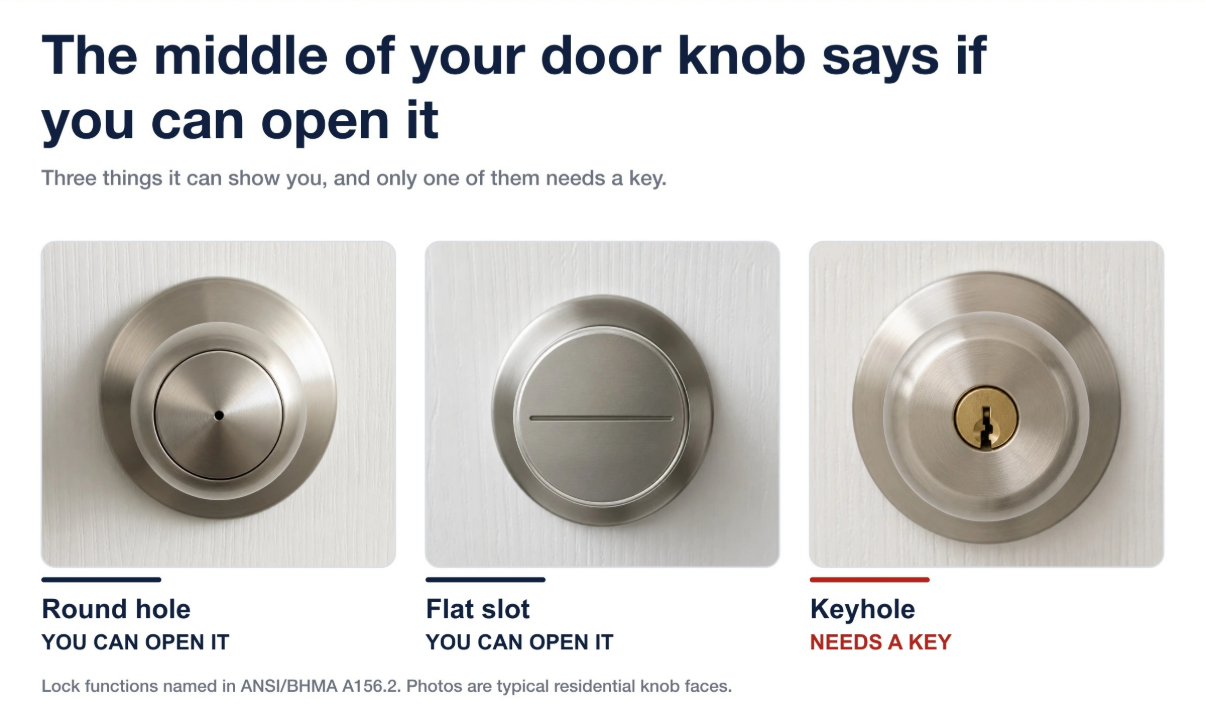
Short answer: the outside face of the knob tells you everything, and there are only three things it can show you.
A small round hole, about the width of a paperclip. A push release, on a privacy lock, which is the kind sold for bedrooms and bathrooms.
A flat slot, like an oversized screw head. The same lock with a release that turns rather than pushing in.
A keyhole, or a blank face under a deadbolt. A keyed lock, and nothing in your pocket opens it.
Where that comes from: lock makers name each of these in ANSI/BHMA A156.2, which is the rule book the lock industry keeps for itself.
One thing fools people here. Plenty of exterior knobs have a tiny hole underneath the handle, and that one is a drain hole for water, not a release. A paperclip pushed into it only bends the paperclip. How you open a locked door depends on which of those three you found, so if it was the hole or the slot, the next section is for you.
How to open an interior privacy lock
How you unlock a bedroom door or a bathroom door from the hallway is the same move, and the manufacturer built it in on purpose. Here is what happens inside the knob.
When somebody presses the button on the inside of a privacy lock, a small rod slides across and stops the handle turning. The release on your side pushes that rod back out of the way. You are not picking anything, you are pressing that button from the wrong side of the door.
Schlage ships the tool in the box and calls it the emergency unlock tool on its installation sheet, and Kwikset sells the same part as number 81087 for its bed and bath range.
If it is a round hole: straighten a paperclip, or take the smallest hex wrench in the drawer. Push it straight in, not at an angle, until it stops against something, then push harder. You will hear a click, the button on the other side pops out, and the handle turns. That is how you unlock a door knob without a key.
If it is a flat slot: use a coin or a small flathead screwdriver, and turn it a quarter turn in either direction. There is no click, and the handle simply starts turning again.
If somebody shut in there is upset or unwell, call 911 first and keep working on the lock.
Why a credit card does nothing to your front door
How to open a locked door with a card is the first trick on every list, and on a modern exterior door it stopped working decades ago. The reason is on your own door, so open it and look at its edge, below the handle.
You will see an angled metal bolt that springs back when you press it. That is the latch. Set into the same metal plate, just above or below it, is a second, much smaller square plunger. That one is the deadlatch, and its whole job is to kill this trick.
Here is what happens when you close the door. The frame presses that small plunger in and holds it there, and with the plunger held in the main latch is blocked and cannot be pushed back on its own. Schlage puts it in one sentence in its commercial lock service manual: "Any function with a dead latch locks the latch bolt when door is closed."
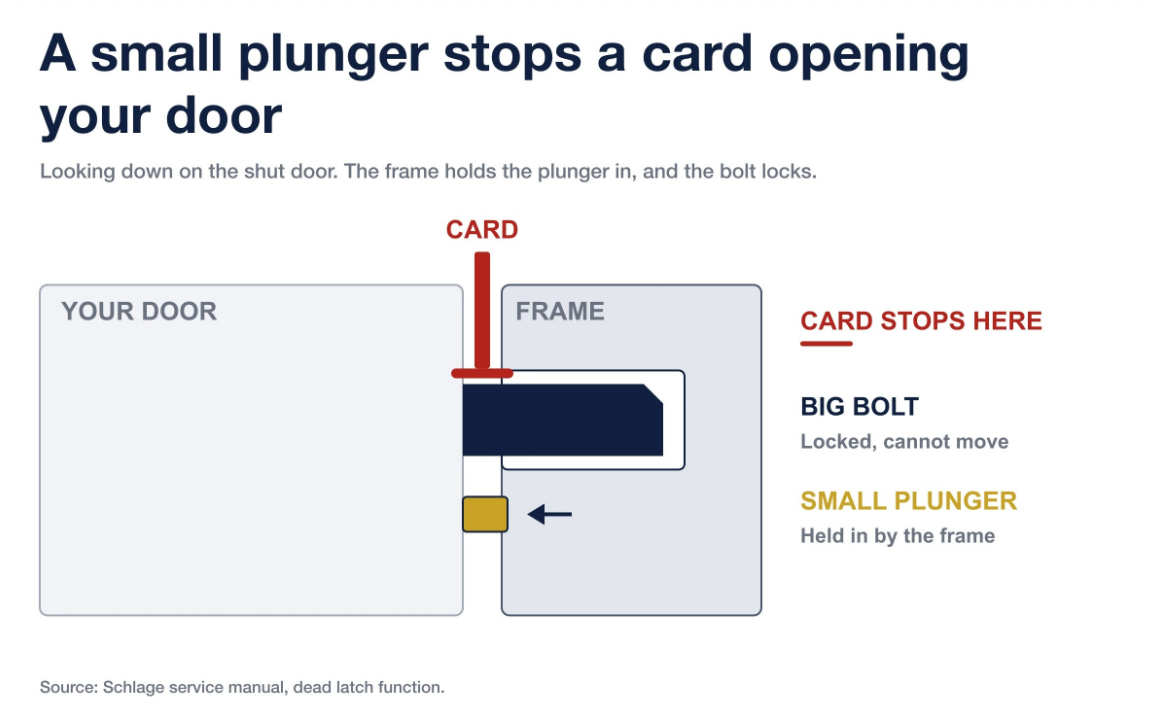
So the card slides in, meets a bolt that will not move, and bends. A thrown deadbolt gives it even less: an angled latch has a sloped face a card can push on, while a deadbolt is a straight steel bar with no slope, so nothing pulls it back but the key. That is why a deadbolt stuck in the locked position is a service call.
What you get when we open it instead
Here is what our call looks like. We pick or shim a keyed lock, so the door opens with no mark and the lock you own keeps working with the same key.
You get asked for identification, and that is the good sign. Our technicians want a photo ID, a lease, or a piece of mail at the address before a tool touches the door.
A key gets cut at the door, and the lock gets rekeyed. If the key is lost rather than shut inside, we cut a new one on the spot, and rekeying rather than replacing changes which key works without new hardware.
FAQ
Is it legal to open a lock on a door I do not own?
No. On a rental, a relative's house, or any property that is not yours, opening the lock can be treated as breaking and entering no matter how easy it was. Call the landlord or the property manager, and let them authorize a locksmith.
What if the outside of the knob is completely blank?
A blank face with no hole, no slot and no keyhole is a passage set, which is a handle with no lock in it at all. That door is stuck rather than locked: swollen wood, a dropped hinge, or a latch no longer reaching its hole. Push the door toward the hinge side as you turn the handle.
Should I drill the lock or try a bump key?
Neither. Drilling the brass cylinder your key goes into destroys a lock that opens undamaged in minutes, so you pay for the opening anyway plus a new lock and new keys. A bump key is a cut key struck to jump a lock's pins, and in several states carrying one is a possession charge. It is also the tool a fake locksmith turns up with.
Shut out right now?
If the door in front of you is a keyed one, a paperclip will not open it. Keyzoo runs mobile locksmiths around the clock in eleven states, and a technician can open the door, cut a key, and rekey the lock in one visit. Book Now and enter your zip code to see who is closest.