Subscribe to newsletter
Subscribe to our newsletter and get updates on the newest posts we release.
By subscribing you agree to our Privacy Policy


High security locks are sold on one promise: a key nobody else can copy. Maybe a tenant moved out and gave back one key after you handed over two. Maybe a contractor kept a set for a week, or a roommate never returned theirs. You want to know whether a better lock fixes that, and what it costs.
It fixes that, and only that. A high security lock is one whose key a store machine cannot copy, and whose keyed part holds out against picking, bumping and drilling. It does nothing for the door itself. If you leave the ordinary lock on, the copy somebody already holds keeps working.
Let us walk through it in the order it happens to you: by the end you will know whether your problem is the key or the door, whether the key in your pocket is already a high security one, which two labels to read on the box, how far key control should go, and what the job costs. I am Eli Itzhaki, and I fit these locks for Keyzoo across 11 states. Often the honest answer is a plain rekey instead.
Key takeaways
A deadbolt and the keyed part inside it are graded by two different standards, so a lock can hold the top hardware grade and still take a copyable key.
A high security key shows what it is: dimples drilled into the flat face, or cuts made at an angle, plus a number stamped near the top.
A top-grade basic deadbolt is published at under $40 and a high security one past $250, so the hardware costs about six times more.
The plate on the door frame is sold separately even by the high security makers, and no lock saves a frame that splits.
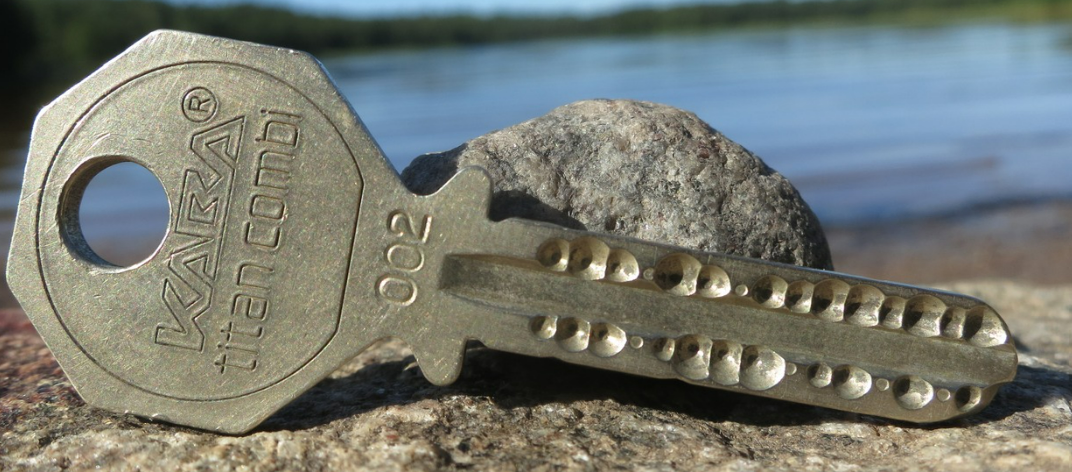
A high security key is cut differently: dimples drilled into the flat face instead of a sawtooth edge, and a stamped number tying it to the record of who may order a copy.
Step one: Decide whether your problem is the key or the door
Short answer: buy a high security lock for the key, not for the door.
A federal survey of household burglaries found the biggest group got in without forcing anything.
Picking, bump keys and copied keys are the three quiet ways in, and this kind of lock is built against all three.
A frame that splits does the same thing whichever lock is screwed to it.
Where that comes from: the Bureau of Justice Statistics survey of household burglary, plus the published tests in step three.
Start with the honest version of the risk. The federal burglary survey, with figures running to 2011, put the largest group as entries made without any force. Nobody beat a lock in those: a door was unlocked, a window was open, or a key already existed.
Key control answers that group, and product pages skip it. Picking means opening a lock with tools instead of a key. Bumping means tapping a specially cut key to jolt the pins inside. Both are quiet, and both leave a door that looks untouched.
Shops sell the answer as bump proof locks or pick proof locks. Neither phrase is honest, because high security locks for doors are timed rather than guaranteed: the test asks how long an attack takes, not whether it can work at all.
The picture below sets what this kind of lock covers against what it leaves alone.
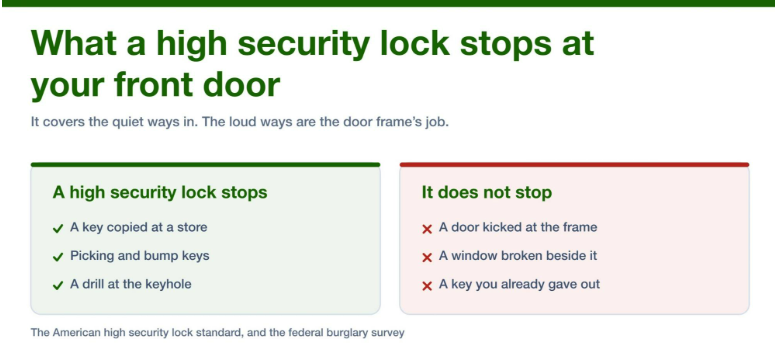
What a high security lock covers at your front door, and what it does not.
Step two: Check whether you already have one
You can check in a minute, and your key gives it away faster than the lock does. Apartment buildings and offices turn one up more often than houses.
An ordinary house key has a sawtooth edge cut along one side and nothing else. A high security key has small round dimples drilled into its flat face, or cuts made at an angle rather than straight down. It also carries a stamped number, which is how the maker tracks who may order another one.
The free test is the counter test: take the key to a hardware store or a key kiosk and ask for a copy. A refusal means you have a high security key, and a copy in two minutes means you do not.
A refusal tells you the key is controlled. It does not tell you how strong the lock is, and those two things carry two separate labels.
Step three: Read the two labels, because each one covers a different part
The two labels cover different parts. One grades the deadbolt as hardware, and the other grades the keyed part, meaning the round barrel your key slides into.
The hardware label is a grade from one to three, set by the trade's own standard for deadbolts. It runs five families of tests, strength and security among them, and Grade 1 is the top. A $39 deadbolt can carry that grade honestly, and it still says nothing about your key.
The key gets its own label. The American high security standard for keyed parts grades them A, B or C, with C the highest. A drill has to be held off for five minutes to reach B and ten minutes to reach C.
It also grades something no hardware test touches: control over who can buy the blank your key is cut from. Underwriters Laboratories runs a separate standard for key locks, and a listed lock has passed an attack test too.
Real products carry both labels at once. The maker of the high security deadbolt I fit most often lists it as Grade 1 on the deadbolt standard, and lists its keyed part to the Underwriters Laboratories one. Settle one more thing before ordering: whether you want a deadbolt that opens from inside without a key, or one that does not.
A grade tells you how long a lock holds out. That is only half of it, because a grade says nothing about who can walk up with a copy.
Step four: Decide how far you want key control to go
Key control decides who may make another copy of your key. Most of my customers who buy one of these locks are buying that and nothing else.
An ordinary lock gives you no control. The blank your key is cut from sells for about a dollar, every hardware store owns the machine, and nobody writes anything down. A high security blank is patented and sold only to named dealers. One maker's catalog says its keys need a special cutting machine too.
Here is the trade-off you are buying: nobody local can cut you a spare, us included. Our own key kiosks cannot cut these keys, and neither can the shop down the road. Every copy goes through the dealer holding your record.
A middle setting exists. A restricted key is cut from a blank the maker sells to one locksmith in an area rather than to the public, so it buys most of the copying control for less money. Ask whichever locksmith you call whether they keep one, and ask them the questions you would ask any locksmith first.
Now you know how far the control goes. The last question is price, and the lock is not the whole bill.
Step five: What high security locks cost, and what else you have to buy
High security locks cost roughly six times a basic deadbolt, and the frame hardware is extra. Today the maker lists a Schlage B60 deadbolt in the top grade at $38.99, and a dealer lists a Medeco Maxum high security deadbolt at $254.45. Fitting comes on top.
Then comes the part that surprises people at the counter. The reinforced plate for the door frame, the one whose long screws reach the wood behind it, is a separate part number in that same maker's catalog. The trade calls that door reinforcement, and the strongest lock made is still screwed to a frame: soft pine with short screws in it breaks before the lock does.
So price the job, not the lock. The frame plate comes first, for a few dollars, and the high security lock comes once you have a key problem. Renters get a shorter version: a fresh rekey on moving day ends the old-tenant problem for far less.
What you get when Keyzoo fits one
These locks are sold through dealers, so the setup matters as much as the box. We measure your door before anything is ordered, so the lock fits the holes already cut. We quote the frame hardware at the same visit.
The key record goes into your name on the day. You leave with the card or signature that every future copy has to clear. And if your door has a key problem rather than a lock problem, we say so, because rekeying the locks you own costs far less than replacing them.
Frequently asked questions
Will a high security deadbolt fit my existing door?
Almost certainly, because these drop into the standard holes. One maker lists its high security deadbolt as fitting doors from 1 and 3/8 inches to 2 and 1/2 inches thick, through the same hole ordinary deadbolts use. A new door is rarely part of the job.
What happens if I lose the only key to a high security lock?
A locksmith takes the lock off rather than picking it open. You paid for a lock nobody picks. Replacement keys are then ordered through the dealer holding your record, so keep that card somewhere other than the house it opens.
Does a high security lock stop lock bumping by itself?
Stopping bumping is one of the things it is designed for. A bump key needs every pin inside to jump on one sharp tap. Makers answer that with angled cuts, pins coming in from the side, and a second bar that all have to be right at once. One tap cannot set all of them.
Not sure who still has a key to your door?
Finding out who still has a key takes a visit rather than a guess. Tell us what the door is, and a Keyzoo technician will price the rekey and the high security option side by side. Book Now.