Subscribe to newsletter
Subscribe to our newsletter and get updates on the newest posts we release.
By subscribing you agree to our Privacy Policy


Most NYC apartment break-ins are crimes of opportunity, not skill. A burglar walks the hallway, finds the one door with a flimsy lock or a gap at the frame, and is inside in under a minute. The good news: the same opportunism that makes apartments vulnerable also makes them easy to protect. A handful of low-cost hardware upgrades and a few habits stop the large majority of break-in attempts before they start. Here’s a practical 2026 security checklist for NYC renters and owners, with what actually moves the needle and what’s mostly theater.
With summer travel season here, this is the right moment to lock things down before you leave town. If you’re weighing specific upgrades, our guides on the best smart locks for NYC homes, rekeying after a move, and what an emergency locksmith should cost pair well with this one.

Why Most NYC Break-Ins Are Preventable?
Apartment burglaries fall into a few predictable patterns: an unlocked door or window, a weak strike plate that pops with one kick, a lock that hasn’t been changed since the last three tenants, or a door left propped during a move. Skilled lock-picking is rare in residential break-ins. Force and opportunity do almost all the work.
That means your goal isn’t to build a vault. It’s to make your door take longer and make more noise to breach than the one down the hall. Burglars optimize for speed and quiet. Take those away and most simply move on.
Start With the Front Door (It’s Where 90 Percent of the Risk Lives)
In an apartment, the front door is the whole game. Fire escapes and windows matter on lower floors, but the entry door is the target in the overwhelming majority of cases. Three upgrades do the heavy lifting.
1. Make sure your deadbolt is Grade 1 or Grade 2
The ANSI grade tells you how much abuse a lock survives. Grade 3 is builder-basic and the first thing to fail under force. For an NYC entry door, you want Grade 2 at minimum, Grade 1 for a street-level or high-traffic building. If you don’t know your grade, a locksmith can read it in seconds, and upgrading a single deadbolt typically runs $150 to $350 installed.
2. Reinforce the strike plate and the frame
This is the highest-value, lowest-cost upgrade most people skip. The standard strike plate is held by two short screws into soft trim. One solid kick splits the frame and the deadbolt comes right through. A reinforced strike plate with 3-inch screws that reach the wall stud, plus a frame reinforcement kit, turns a one-kick door into one that holds. Expect $50 to $150 with a locksmith, and it does more for real-world security than almost any lock swap.
3. Rekey or replace the moment you move in
You have no idea how many working keys exist for a lock you didn’t install: prior tenants, their exes, contractors, brokers, the super. Rekeying invalidates all of them and is far cheaper than replacement. We break down the full pricing in our rekey cost guide, but the short version: do it in the first week, before you’ve unpacked.
Lock Habits That Matter More Than Hardware
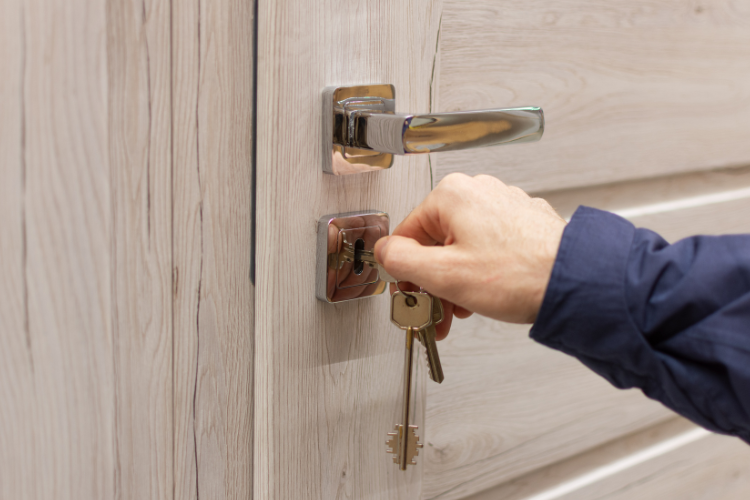
The best deadbolt in the building does nothing if it isn’t thrown. A few habits close the gaps that hardware can’t:
- Throw the deadbolt every time, even for a five-minute errand. A spring-latch knob alone is trivial to slip.
- Never hide a spare key outside. Burglars check the doormat, the planter, and the frame ledge first. Leave a spare with a trusted neighbor or use a quality lockbox instead.
- Don’t buzz strangers into the building. Tailgating through the lobby is how most non-tenants get to your floor in the first place.
- Don’t label your keys with your address or apartment number. A lost keyring becomes a free pass.
- Break down delivery boxes for big purchases (TVs, electronics) before putting them in the hallway or recycling. An empty box on the curb advertises what’s inside.
Windows, Fire Escapes, and Back Doors
On the ground floor, in a garden unit, or next to a fire escape, your windows are part of your perimeter. Quick wins:
- Add window locks or pin locks so a window can’t be slid open more than a few inches. Inexpensive and effective.
- Fit a security bar or dowel in the track of sliding windows and balcony doors.
- Make sure fire-escape windows still open from the inside in an emergency. Use approved gates, never permanent bars, which are illegal and deadly in a fire.
- Treat a back or service door like a front door: same grade deadbolt, same reinforced strike plate.
Anything that touches a fire escape has to stay code-compliant. A licensed locksmith can recommend FDNY-approved window guards and release-style gates that secure the opening without trapping you inside.

Going Away This Summer? A Pre-Travel Security Checklist
An apartment that looks empty for a week is the softest target there is. Run through this before you leave:
- Stop or forward mail and packages so nothing piles up at your door or mailbox.
- Put a couple of lamps on timers so the unit shows signs of life after dark.
- Tell one trusted neighbor you’ll be away and ask them to grab any stray deliveries.
- Don’t announce the trip publicly on social media until you’re back home.
- Double-check every window and the back door, not just the front.
- If a smart lock with an activity log is on your list, install it before you go so you can see exactly when the door opens while you’re away.
- If you’ve recently lost a key or had a roommate move out, rekey before the trip rather than after.
Security Upgrades Ranked by Cost and Impact
Where to spend first if you’re working through this list:
Notice that the two cheapest upgrades, rekeying and a reinforced strike plate, sit at the top for impact. Spend there before anything fancy.
Frequently Asked Questions
Do I need my landlord’s permission to change the locks in a NYC rental?
Usually yes. Most NYC leases require landlord approval before changing or rekeying locks, and many buildings need the new pins to stay compatible with the building master key. Rekeying (rather than replacing) is the path of least resistance and keeps you on good terms. Always check your lease first.
What’s the single most effective security upgrade for an apartment?
A reinforced strike plate with 3-inch screws into the stud. It’s cheap, it’s fast, and it defeats the most common attack on an apartment door, which is brute force against a weak frame. Pair it with a Grade 1 or Grade 2 deadbolt and you’ve handled the realistic threat.
Are smart locks safe, or do they just add a hacking risk?
Reputable smart locks from major brands are safe for residential use, and the activity log is genuinely useful for knowing who comes and goes. The realistic risk isn’t remote hacking, it’s a weak PIN or a model with no mechanical key backup. See our smart locks guide for the picks that handle both well.
How do I secure a ground-floor or fire-escape apartment?
Treat your windows as entry points: add track locks or window pins, and use FDNY-approved window guards or release gates near the fire escape so you stay code-compliant. Never install permanent bars, they’re illegal and a fire hazard. A locksmith can fit approved hardware that secures the opening without trapping you.
What should I do if I think someone has a key to my apartment?
Rekey the locks, ideally same-day. Rekeying changes the pin configuration so every existing key stops working, including any copy you don’t know about. It’s faster and cheaper than replacement. If you’re locked out or it’s urgent, a mobile locksmith can usually handle it on the spot.
Does a video doorbell actually deter burglars?
To a degree. A visible camera raises the perceived risk of being identified, which pushes opportunists toward an easier target. It won’t stop a determined intruder on its own, so treat it as one layer on top of a solid door, not a replacement for good hardware.
Want a Security Walkthrough From a Licensed NYC Locksmith?
Keyzoo runs licensed mobile locksmith service across Manhattan, Brooklyn, Queens, the Bronx, and Staten Island. We’ll read your door’s lock grade, check the strike plate and frame, rekey on the spot, and recommend code-compliant window and fire-escape hardware, all at a flat rate quoted before any work begins.
Ready to lock things down before summer? Book a security assessment with Keyzoo or see our full NYC locksmith services. For independent consumer guidance on home security and choosing a legitimate locksmith, the ALOA Security Professionals Association is the industry body we operate under.
——