Subscribe to newsletter
Subscribe to our newsletter and get updates on the newest posts we release.
By subscribing you agree to our Privacy Policy


The fastest way to secure your home before vacation is to lock and test every door and window, deal with your spare keys, and make the house look lived in while you are gone. Throw and test each deadbolt, pin your sliding doors, latch the windows, hand one key to a trusted neighbor instead of hiding it outside, and put your lights, mail, and garage on a plan. If you are not sure who still has a copy of your key, this is the right moment to rekey your locks so old keys stop working. Below is the full pre-trip checklist we walk homeowners through, in the order that matters most.
Why empty summer homes are the easiest target
Empty homes are easy targets in summer because more families travel and more houses sit dark for days at a time, and the data backs it up. According to the Bureau of Justice Statistics (2014 report on seasonal crime, using National Crime Victimization Survey data from 1993 to 2010), household burglary rates were higher in summer than in any other season. The same report found burglary rates were about 11% lower in winter, 9% lower in spring, and 6% lower in fall than in summer.
Summer is not the only risk window. Break-ins happen year-round, and any stretch when your house sits empty raises the odds, including the winter holiday travel weeks. The July Fourth travel week is a good example, with a lot of homes going quiet at once. The takeaway is not to worry. It is that a short routine before you leave removes the easy opportunity most burglars are looking for, since most are opportunistic rather than planning around your specific house.
About us: Keyzoo is a national locksmith brand. We handle residential, commercial, and automotive lock work across the United States, and pre-trip home security is one of the most common things homeowners call us about.
Your pre-trip door and lock check: deadbolts, strike plates, and sliding doors
Securing your home before vacation starts at the doors, because forced entry through a door is one of the most common ways burglars get in. Walk every exterior door and do three things.
Throw and test each deadbolt. A deadbolt only protects you when it is fully extended. A quality deadbolt has about a one inch bolt throw, and for an exterior door you want an ANSI/BHMA Grade 1 or Grade 2 lock. If the bolt sticks or only goes halfway, fix it before you leave.
Check the strike plate screws. This is the cheapest upgrade we install and the one most homes are missing. Many strike plates are held by short half inch screws that bite only into the doorjamb trim. Swapping them for three inch screws that reach the wall framing makes the door far harder to kick in. Driving a couple of longer screws is a safe job for most homeowners. If the door or frame is already damaged, call a pro instead of forcing it.
Secure sliding glass doors. Sliding patio doors are a known weak point, because older ones can be lifted out of the track. Drop a sturdy bar or a cut dowel into the track so the door cannot slide, and consider an aftermarket pin or auxiliary lock. If a slider feels loose in its track or the latch does not catch, have it serviced before a long trip.
Spare keys, fake hide-a-keys, and who should hold one while you travel
What to do with your spare keys when on vacation is simple: bring the hidden ones inside and give one key to a person you trust, not a hiding spot. Burglars know the spots. The mat, the planter, the top of the door frame, and the plastic fake rock are the first places checked, and they take seconds to find.
Give a key to a trusted neighbor, friend, or family member who can check the house, grab the mail, and respond if something looks off.
Use a coded key lockbox, the kind real estate agents use, mounted out of sight, with the code shared only with the person who needs it.
If you cannot account for every copy of your key, or a former tenant, contractor, or ex still might have one, rekey before you go. More on that next.
A neighbor with eyes on the house is worth more than any gadget. Ask them to park in your driveway now and then and to bring in any stray package.
Should you rekey or add a smart lock before a big trip
Should you rekey your locks before vacation, or add a smart lock? Rekey if your goal is to make old keys stop working at low cost. Add a smart lock if you want to lock up, check the door, and let someone in from anywhere while you are away.
Rekeying changes the pins inside your existing lock so a new key works and all old keys stop. It is fast, keeps your current hardware, and is the right call when you have lost track of who has a copy. See our breakdown of rekeying versus replacing your locks if your hardware is older.
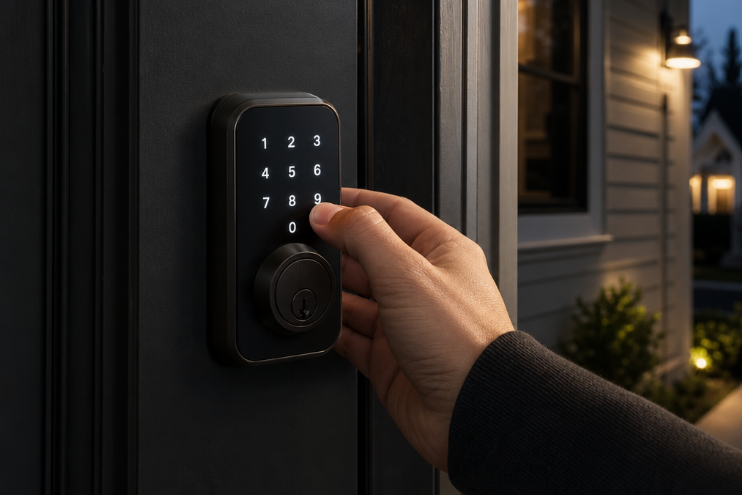
Smart locks earn their keep while you travel. Do smart locks help when you are away? Yes. You can confirm the door is locked from your phone, get alerts, set the lock to auto-lock, and hand a cleaner or pet sitter a temporary code instead of a key. If you want one, our guide to smart locks that work with Alexa and Google Home is a good starting point. A smart lock depends on batteries and Wi-Fi, so change the batteries before a long trip.
Rekey vs smart lock: a quick decision guide
These figures are rough estimates that change by brand, lock count, door condition, and your local market. They are not a quote. Always get a written, itemized quote before any work.
Which is right for you: If your main worry is an unknown key floating around, rekey and you are done. If your main worry is checking on the house or letting someone in while you are gone, a smart lock is the better fit. Plenty of homeowners do both: rekey the deadbolts and add one smart lock on the door they use most.
 .
.
The 10-minute leaving-for-a-week checklist (windows, lights, garage, mail)
Here is the leaving house for a week security checklist we give homeowners, and most of it takes about ten minutes.
Windows: latch every one, including upstairs and the small bathroom and basement windows people forget. Add a dowel in sliding window tracks.
Lights: put a couple of lamps on timers or smart plugs so they switch on and off in the evening. A house that stays dark for seven straight nights signals an empty home.
Blinds: leave them roughly as you normally keep them. Fully shut blinds for a week look off.
Mail and packages: place a USPS Hold Mail request and pause deliveries, or have a neighbor collect them. A pile of mail and boxes is a clear sign no one is home.
Garage: close the garage door and lock the interior door between the garage and the house, which is often left unlocked. If your opener has a vacation or lock mode, use it.
Alarm and cameras: arm your system and make sure a trusted person knows how to respond to an alert.
Social media: wait until you are home to post the vacation photos. Announcing an empty house to the internet undoes the rest of this list.
Spare key: confirm your neighbor has the one key and knows your return date.
Frequently asked questions
Should I rekey my locks before vacation?
Rekey before vacation if you cannot account for every copy of your key, recently moved, or had contractors, a former tenant, or an ex with access. It cancels all old keys at once and usually takes a locksmith well under an hour.
Do smart locks help when you’re away?
Yes. A smart lock lets you confirm the door is locked, get alerts, and give a pet sitter or cleaner a temporary code from your phone, so you are not hiding a key or driving home to check. Change the batteries before a long trip.
What to do with spare keys when on vacation?
Bring any outdoor hidden keys inside and give one key to a trusted neighbor, or use a coded lockbox out of sight. Skip the doormat, planter, and fake rock, since those are the first spots a burglar checks.
How do I burglar-proof my house before a trip without spending much?
The cheapest wins are free or close to it: throw and test every deadbolt, swap strike plate screws for three inch ones, bar your sliding doors, latch all windows, put lights on timers, and hold your mail. None of these require new locks.
Is summer really when most break-ins happen?
Burglary rates run higher in summer than other seasons in the United States, according to the Bureau of Justice Statistics (2014). Break-ins still happen year-round, so the same checklist applies to any trip, including winter holidays.