Subscribe to newsletter
Subscribe to our newsletter and get updates on the newest posts we release.
By subscribing you agree to our Privacy Policy


Not yet, but the gap is closing. The Aliro smart lock standard, published by the Connectivity Standards Alliance in February 2026, lets your phone or smartwatch work as a house key by storing a secure digital key in your Apple, Google, or Samsung wallet. Your metal key is not disappearing anytime soon, and as a locksmith, I will tell you that is a good thing. Here is what Aliro actually changes, and whether it makes more sense to buy a smart lock today or wait for an Aliro model.
Keyzoo is a national, 24/7 locksmith. We install, rekey, and service residential locks across the country, from plain deadbolts to the newest smart locks, so the “should I go keyless?” question comes up on real jobs every week. If you want the full breakdown of keypad versus fingerprint versus app locks, we cover that in our guide on how to choose a smart lock in 2026. This post is about the new part: the Aliro standard, the phone-as-house-key idea behind it, and the honest buy-now-or-wait call.
What the Aliro smart lock standard actually is, in plain words
Aliro is an open standard for mobile access credentials, which is a plain way of saying it lets one phone open many brands of lock without a separate app for each one. The Connectivity Standards Alliance, the same group behind the Matter smart-home standard, released the Aliro 1.0 specification in February 2026 and named Apple, Google, Samsung, Allegion (the maker of Schlage), Kwikset, Aqara, and HID among the first companies expected to certify products. Think of it like a card in your digital wallet. Instead of a credit card, you carry a door key, and any lock that speaks the same language will accept it.
How a phone-based door credential works (wallet, tap, and hands-free range)
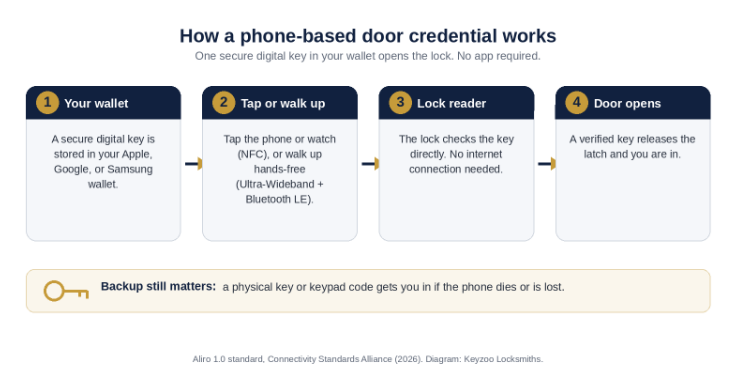
A phone-based door credential lives in your phone's wallet app and talks to the lock directly, with no internet connection needed. You get in one of two ways. The first is a tap: you hold your phone or watch near the reader and it opens over Near-Field Communication (NFC), the same short-range tech behind tap-to-pay. The second is hands-free: on locks and phones that support Ultra-Wideband (UWB) plus Bluetooth Low Energy, the door can sense you walking up and release the latch without a tap. Apple's Home Key has worked this way on iPhone for a while. Aliro takes that same experience and turns it into a shared standard, so it is not tied to one brand.
What it fixes: one lock that works with iPhone, Android, and Samsung
The real problem Aliro solves is the mixed household. Right now, if you own an iPhone and your partner carries a Samsung, finding one smart lock that gives you both a smooth phone key is genuinely hard. Apple Home Key locks favor iPhone, and Android and Samsung support has been patchier. A smart lock that works with iPhone and Android through the same standard means everyone in the house uses the same digital key, and guests can too, whatever phone they carry. That is the promise. To be clear, on iPhone you can already get much of this today with an Apple Home Key lock. Aliro's biggest win is bringing that convenience to Android and Samsung and making it consistent across brands.
Buy a smart lock now or wait for Aliro: an honest comparison
Here is the honest part, and it is the reason people ask us at all. As of mid-2026, the Aliro standard is published, but certified consumer locks are still rolling out, and most brands have announced support without committing to firm ship dates. Waiting could mean waiting a while. It also matters that most existing smart locks cannot be moved to Aliro with a software update, because the standard needs specific radio chips inside the lock. So “wait” usually means “buy new hardware later,” not “upgrade the lock I already have.”
What you compare | Buy a smart lock today | Wait for an Aliro-certified lock |
|---|---|---|
The short version: if you want a phone key today and you are an iPhone household, a current Apple Home Key lock already delivers most of it. If your household mixes iPhone and Android and you can wait, an Aliro model is worth holding out for. On cost, a quality residential smart lock generally runs in the low-to-mid hundreds of dollars installed, but that is a rough range that varies by lock, door, and market, and it is not a quote. Always get a written, itemized price before you commit. For the specific models we install and trust, see our current best-smart-locks list.
What happens if your phone dies or you lose it, and why a physical key or code backup still matters
If your phone dies, a smart lock with a backup still gets you in; a phone-only setup does not. This is the single most common smart-lock problem we see on lockout calls: a dead phone battery, or a lost phone, and no other way through the door. Every smart lock we recommend keeps at least one backup, a physical key cylinder or a keypad code, and we tell homeowners to set up both and keep a real spare key somewhere safe. If you do get locked out, do not force the door or try to pull the lock apart, because you can damage the hardware and the door. Call a licensed locksmith instead. If you have lost the phone that held your key, treat it like a lost key fob and remove that credential from the lock right away. And if you are moving into a place with an unknown key history, rekeying the cylinder is still the fastest way to control who can get in.
What a locksmith would tell you before you buy
Buy the lock, not the logo. After years of installing these, the models that hold up are the ones that get the security basics right: a solid deadbolt, a good ANSI grade, a proper fit for your door, and a reliable backup. A phone key is a convenience layered on top, not the reason a door is secure. Three honest pointers. First, if you want hands-free walk-up today, buy a lock with Ultra-Wideband now rather than waiting, because that experience already exists. Second, do not expect to move your current lock to Aliro by software; plan to buy new hardware when the certified models arrive. Third, whatever you choose, keep a physical key or keypad code and a spare key off-site. And if you are wondering how safe these locks really are in the first place, see what our 2026 testing found about smart lock security.
Will my phone replace my house key? Not completely, and not yet. Your phone can act as your main key on an Aliro or Apple Home Key lock, but you should keep a physical key or keypad code as backup for dead batteries and lost phones. Does the Aliro standard work with iPhone and Android? Yes. That is the point of it. Aliro stores your door credential in the Apple, Google, or Samsung wallet, so one lock can work for a mixed iPhone and Android household (Connectivity Standards Alliance, 2026). Can I add Aliro to my current smart lock? Usually no. Aliro needs specific radio hardware inside the lock, so most existing models cannot be updated with a software patch. Look for locks labeled Aliro-certified or Aliro-ready. What happens if my phone dies and I have a smart lock? Use your backup: a physical key or your keypad code. If you have neither and you are locked out, call a licensed locksmith rather than forcing the door. Should I wait for an Aliro lock or buy one now? If you are an iPhone household and want a phone key today, a current Apple Home Key lock already delivers it. If your household mixes phone brands and you can wait, an Aliro model is worth holding out for. More locksmith guides: the Keyzoo blog.FAQ