Subscribe to newsletter
Subscribe to our newsletter and get updates on the newest posts we release.
By subscribing you agree to our Privacy Policy


Is Summer Really Burglary Season? New FBI Data Says It Depends Where You Live
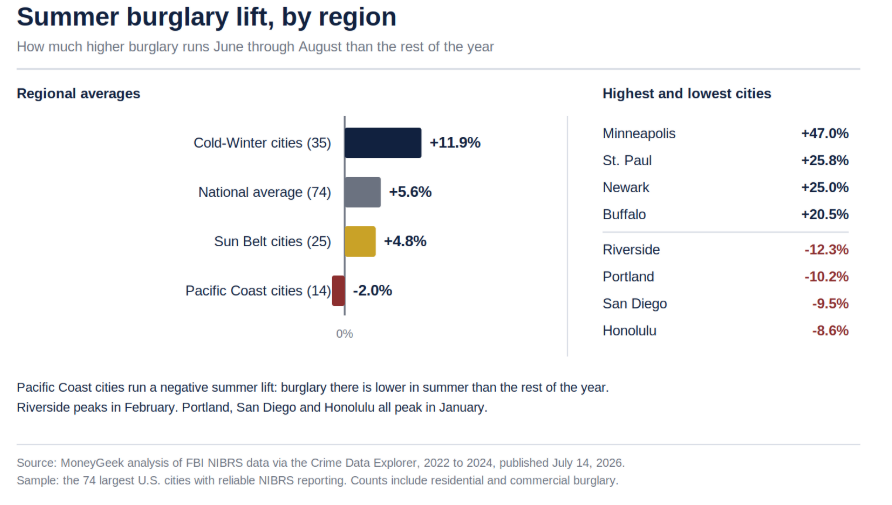
Summer is burglary season in cold-winter cities, and close to nowhere else. Across the 74 largest U.S. cities, burglary in June through August runs only about 5.6% above the rest of the year. On the Pacific Coast it runs lower in summer than in winter. Your real risk window is set by your climate, not by the calendar every security ad quotes.
What the new burglary data actually found
The seasonal spike is real in some places and reversed in others. MoneyGeek pulled three years of monthly burglary counts from the FBI's Crime Data Explorer, covering 2022 through 2024 in the 74 largest cities with reliable reporting, and published the results on July 14, 2026. The measure is straightforward: compare a city's average monthly burglary count in June through August against its average for the other nine months. Group the cities by climate and the national average falls apart.
Region | Cities | Summer lift | What it means |
|---|---|---|---|
The split is consistent rather than anecdotal. Comparing every cold-winter city against every Pacific Coast city, the cold-winter city has the higher summer lift in 425 of 490 matchups. Eighteen of the 74 cities post a negative summer lift outright.
Why the pattern flips on the coast
Cold winters create the summer spike, and mild ones prevent it. Minneapolis police log roughly 283 burglaries a month in summer against about 193 the rest of the year. Riverside, California runs the opposite way, about 118 a month in summer against 134 otherwise, and its peak lands in February.
Two forces line up behind that. The first is climate contrast. A hard winter suppresses break-ins, which leaves room for a rebound once the weather turns, and a city that never has the trough has nothing to rebound from. The second is absence. Burglary is an opportunity crime, and the seasonal emptying of houses for vacations and university breaks is far more pronounced in northern cities.
The researchers are careful about causation, and so am I. Monthly counts cannot isolate one force from another, and the FBI's monthly aggregates fold commercial burglary in with residential, which the full methodology states plainly. The pattern is solid. The explanation is a reasonable read, not proof.
When is your burglary season?
Find your city, or the closest one to it, and use its peak month as the anchor for anything you do seasonally: light timers, camera checks, a mail hold, telling a neighbor you are away.
City | Region | Summer lift | Peak month |
|---|---|---|---|
Two things stand out to me in that list. New York is close to flat, so a New Yorker timing security around summer is timing around nothing. And a Southern California household following national summer advice is running its checklist six months out of phase with its own risk.
The 5 things I check first on any front door
Seasonality tells you when to pay attention. It does not tell you what to fix. Roughly 34% of break-ins come through the front door, with first-floor windows at 23% and back doors at 22%, according to ADT figures compiled alongside the FBI data. That is the order I work in, and here is what I look at before anything else.
1. How far the bolt actually throws
I want a full inch of bolt sitting inside the frame. Short throw is common on doors that have settled, and the tell is a homeowner who lifts or leans on the door to get the key to turn. What happens next is predictable: people stop throwing the deadbolt at all and rely on the knob latch, which is not a lock in any meaningful sense.
2. The screws in the strike plate
This is the cheapest fix in the trade and the one I replace most. Factory strike plates ship with three-quarter-inch screws that bite into the jamb trim and nothing else. Three-inch screws reach the framing stud behind it. A kicked door usually fails at the jamb, not at the lock, so a strong deadbolt in a plate held by short screws is a strong deadbolt on a weak door.
3. The grade stamped on the hardware
Locks are rated by the American National Standards Institute and the Builders Hardware Manufacturers Association, written ANSI/BHMA, with Grade 1 the strongest and Grade 3 the lightest. Grade 3 deadbolts turn up constantly on builder-grade front doors. They are fine on a shed and thin for a main entry.
4. The doors nobody thinks about
Garage entry doors, side doors, and patio sliders are where I find the gap. A household will spend real money on the front door, then leave the door from the garage to the kitchen on a hollow-core slab with a knob lock. Anyone already inside the garage has privacy and time, which is the whole game.
5. How many keys are unaccounted for
I ask every customer to count the keys to their house out loud. Almost nobody can. Contractors, a previous owner, an old roommate, a dog walker, a cleaner who moved on: the copies exist, they do not expire, and no amount of seasonal vigilance covers a key that walks through the front door in daylight.
What matters more than the month
Hardware does not have a season. Homes made up 56.2% of the 839,563 burglaries reported nationally in 2023, and break-ins split almost evenly between daytime and overnight hours, per FBI Crime Data Explorer figures. A bolt either reaches the framing or it does not, in January and in July alike.
So split the job in two. The seasonal half, timers and mail holds and camera checks, should follow your region's peak month from the table above. The permanent half, the five checks above, gets done once and then left alone. If you only have an afternoon, spend it on the second half.
Frequently asked questions
What month do most burglaries happen?
It depends on your city. Minneapolis and St. Paul peak in July, Newark in June, Atlanta and St. Louis in August, while Portland, San Diego, Honolulu and Los Angeles all peak in January and Riverside in February, according to the 2026 MoneyGeek analysis of FBI data.
Is summer burglary season a myth?
It is a regional truth sold as a national one. Cold-winter cities average an 11.9% summer increase, but the national figure is only 5.6% and Pacific Coast cities average a 2% decrease.
What is the most common way burglars get into a house?
The front door, at roughly 34% of break-ins, followed by first-floor windows at 23% and back doors at 22%. That is why door hardware is worth more attention than most homeowners give it.
Does a deadbolt actually stop a break-in?
A properly installed one raises the effort and noise required a great deal. Most failures I see are installation problems rather than lock problems: a bolt that does not fully extend into the frame, or a strike plate anchored to trim instead of framing.
When should I do my seasonal home security check?
Use your city's peak month as the trigger. In cold-winter cities that means late spring, before the June through August window. On the Pacific Coast it means late fall, ahead of a January or February peak.
Getting a second set of eyes on your doors
I write this as a technician with Keyzoo Locksmiths, a licensed locksmith company working on homes and businesses nationwide, around the clock. The five checks above are the same ones our technicians run on a residential visit, and most of what they turn up is fixable in a single appointment: a strike plate anchored properly, a bolt realigned, a lock rekeyed so the loose copies stop working, or a tired deadbolt swapped for a better grade. If you are heading out of town first, our pre-vacation security checklist covers the seasonal half of the list.