Subscribe to newsletter
Subscribe to our newsletter and get updates on the newest posts we release.
By subscribing you agree to our Privacy Policy


You went to buy a smart lock for the front door, and the box says it fits a single cylinder deadbolt. Then you walk over to your own door and nothing matches. There is one keyhole sitting above the handle, a small thumbturn on that same metal plate, and no separate deadbolt anywhere. So you are stuck before you start. Is your lock just old? Is it the wrong kind? Did somebody put the cheap thing on the most important door in the house?
Nothing is wrong with your door. You have a mortise lock, and it is the one I get asked about more than any other. I am Eli Itzhaki, and Keyzoo works on locks like this across eleven states, so I have opened a lot of these doors. Your lock is probably better built than the one in the box, and it plays by different rules. Knowing which rules saves you money, and the cheap answer is often a rekey rather than new hardware, which we compare in our guide to rekeying instead of replacing a lock.
The short answer
A mortise lock is one metal box that lives inside a pocket cut into the edge of your door, and that single box holds both the latch and the deadbolt.
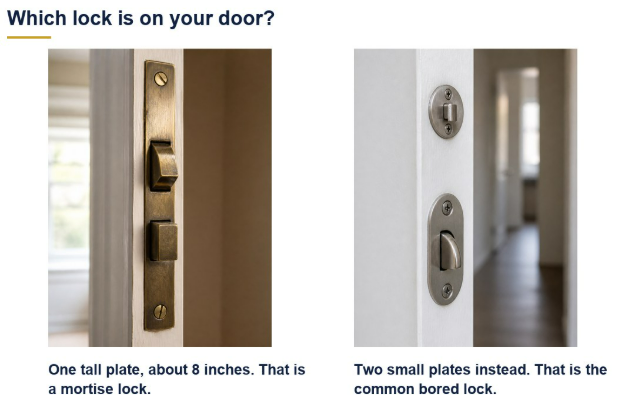
Open the door and look at its edge. A tall rectangular plate, roughly 8 inches from top to bottom, means you have a mortise lock.
A small round or oval plate about an inch across means you have the common bored lock instead, the kind almost every new house gets.
One body does both jobs, which is why there is no second deadbolt above your handle.
Most stick-on smart locks will not fit it. August lists mortise locks by name as hardware it does not work with.
Here is why that holds up: mortise locks are common enough in the United States to have their own national standard. The Builders Hardware Manufacturers Association writes it, and ANSI/BHMA A156.13 sets performance requirements for mortise locks and latches, with operational, cycle, strength, material, security and finish tests behind each grade.
By the end you will know how to tell in ten seconds which lock you have, why your house got one when your neighbor's did not, whether a smart lock can go on it, and what a repair or a swap costs.
Key takeaways
The plate on the edge of the open door tells you everything. Tall and rectangular is mortise; small and round is not.
A mortise lock is one body doing two jobs, so you get a latch and a deadbolt without a second lock on the door.
The cylinder, which is the part your key goes into, screws out on its own. That is why a rekey is usually cheap.
Retrofit smart locks are built for single cylinder deadbolts, and August names mortise locks on its incompatible list.
Homes are getting older, so more people are meeting this lock for the first time. The middle American home is now 42 years old.
How do I tell if I have a mortise lock?
mortise-vs-bored-edge.jpg · 1160x744 · mobile variant: mortise-vs-bored-edge-mobile.jpg (760x1739) · alt text: Door edge with one tall mortise faceplate beside a door edge with two small bored lock plates
Open the door and look at the skinny edge where the latch pokes out. That is the whole test, and it takes about ten seconds.
On a mortise lock you will see a long rectangular plate running up and down that edge, around 8 inches tall and an inch wide. One screw holds it near the top and one near the bottom. Often two bolts stick out of it: an angled latch that catches when you close the door, and a square deadbolt that only moves when you turn the key or the thumbturn.
On the common bored lock you see something much smaller: a round or oval plate about an inch across with the latch in the middle. A deadbolt, if the door has one, gets its own small plate a few inches higher.
The front of the door gives you a second clue. When the keyhole sits in its own plate above the handle rather than in the middle of the knob, that is another sign of a mortise lock. Now that you can name it, the next question is what does the work in there.
What is actually inside the door?
Cut a rectangular pocket into the edge of a door and you have made a mortise. The lock takes its name from that pocket, which is old woodworking language rather than lock language. The lock body slides into that pocket and gets screwed to the edge through the long faceplate.
Inside that body, one set of parts runs the springy latch and another runs the solid deadbolt. The handle turns the latch. Your key turns the deadbolt. Because it is all one assembly, the door needs one pocket instead of the two round holes a modern lock needs drilled through it.
The piece your key actually goes into is a separate part called the cylinder, and on a mortise lock it screws in like a light bulb. That detail saves people real money, and I come back to it further down.
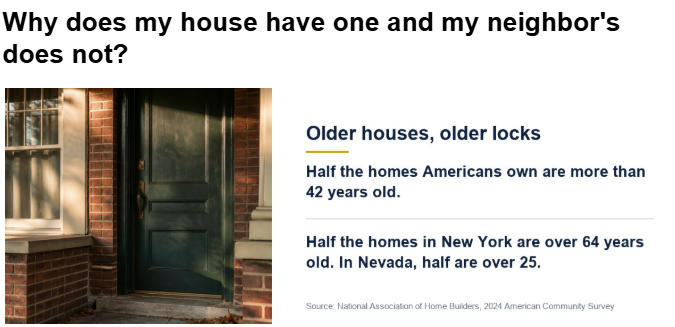
Age, mostly. Cutting a clean pocket into a door edge takes a chisel and time, while drilling two round holes takes a jig and a few minutes. Once builders had the faster way, new houses stopped getting mortise locks and commercial buildings kept them.
So you can guess roughly when your door was hung from the lock on it. That matters more every year, because American houses keep getting older. In its March 26, 2026 look at the housing stock, the National Association of Home Builders found the middle owner-occupied home in America is now 42 years old. It also found that 47% of them are at least 45 years old, up from 39% in 2014.
Where you live changes the odds a lot. The same group's state by state breakdown puts the middle home in New York at 64 years old and in Massachusetts and Rhode Island at 59, while Nevada sits at 25 and Texas at 28. We work in states at both ends of that list, and it shows up in the calls: mortise questions come from the older markets, and almost never from the newer ones.
Can I put a smart lock on a mortise lock?
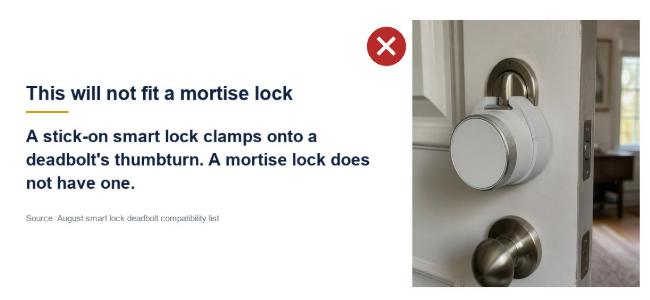
Not the popular kind, no. The smart locks people buy to keep their own keys work by pulling off the thumbturn on the inside of a deadbolt and bolting themselves to the plate underneath. Your mortise lock has no such plate, because the thumbturn is part of the handle set.
You do not have to take my word for it. August publishes the list. It says the locks work only with single cylinder deadbolts, then names mortise locks first among the hardware it does not fit. If a listing does not say it fits a mortise lock, assume it does not.
You still have choices, and here is the one I suggest first. Ask whether the door has room above the handle for a second, separate deadbolt. When it does, you keep the lock you have and add a normal smart deadbolt in the new spot, which is the cheapest way to get a keypad. When it does not, you are choosing between a smart mortise lockset and converting the pocket, and both need hardware picked around the exact pocket already cut in your door. Either way, picking the smart lock itself is a separate decision worth making after you know what fits.
Do I rekey it, fix it, or replace the whole thing?
People assume an old mortise lock means a full replacement. Usually it does not. These are the five things I check before I quote anything.
Is the cylinder the only problem? Because it screws out on its own, a key that sticks or a lock you want keyed to match the back door is often a twenty minute job. Nothing else in the door gets touched.
Does the handle feel sloppy or gritty? Wear inside the body is repairable on plenty of older locksets, and a lock repair beats buying a new one when the parts still exist.
Is it a skeleton key lock? A big open keyhole with no cylinder means a bit key lock, which offers almost no security by today's measure. That one I do recommend changing.
Does the pocket match anything sold today? A replacement body has to fit the hole already cut in your door. Before you call anyone, measure the height of the plate on the door edge and the distance from that edge to the middle of the keyhole, then photograph the edge with the door open. Those three things tell us in one message whether stock hardware will drop in.
Is the door itself the trouble? Doors sag, and a bolt that no longer lines up with the hole in the frame feels exactly like a broken lock. Fixing the alignment is cheaper than any hardware.
One more thing worth knowing if anybody in the house has arthritis or a weak grip. Federal accessibility rules for public buildings say door hardware has to work with one hand, without tight grasping, pinching or twisting your wrist, under section 309.4 of the ADA Standards. That is why office doors get levers instead of knobs, and swapping a mortise knob for a lever handle is a small change that copies it at home.
What does a mortise lock cost?
These are typical national ranges, not a quote. What you pay depends on the hardware you choose, the shape the door is in, and your market.
Work | Typical national range |
|---|---|
Solid brass handle sets cost well above that last row, and antique finishes take longer to find. If you want a working front door rather than a period-correct one, say so up front, because it changes the quote.
Frequently asked questions
Is a mortise lock more secure than a regular deadbolt?
Built well, yes, because the bolt sits in a deep body rather than a shallow drilled hole. A hundred year old one with a worn cylinder is not, and neither is any lock on a frame held by short screws. The frame matters as much as the lock.
Can a locksmith make a key for it without the original?
Usually. The cuts can be read out of the cylinder itself, so a lost key is not the end of the lock. Bring us the door, or we come to it.
Will I be able to get parts in ten years?
Almost certainly, because schools, hotels and offices still buy mortise locks by the pallet. Bodies, cylinders and faceplates are current stock items, not antiques, even when the door they go into is from the 1930s.
Can I install one myself?
Swapping a cylinder is a reasonable weekend job. Cutting a new pocket is not, since the pocket has to be square and sized to the body or the door is ruined. When a door already has the pocket, get someone to measure it before you order anything.
There is a keyhole on the inside of my door too. What does that mean?
That is a double cylinder lock, and it needs a key from both sides. Builders used them on doors with glass next to the handle, so that breaking the glass does not let someone reach in and turn a thumbturn. The trade-off is real: nobody gets out that door in a hurry without the key.
Get the lock on your door working
Whether it needs a rekey, a new cylinder, or a full lockset sized to the pocket already in your door, we can tell you which one it is before any hardware gets ordered. Book a locksmith at keyzoo.com/booking/zipcode and we will come out and look at the door.