Subscribe to newsletter
Subscribe to our newsletter and get updates on the newest posts we release.
By subscribing you agree to our Privacy Policy


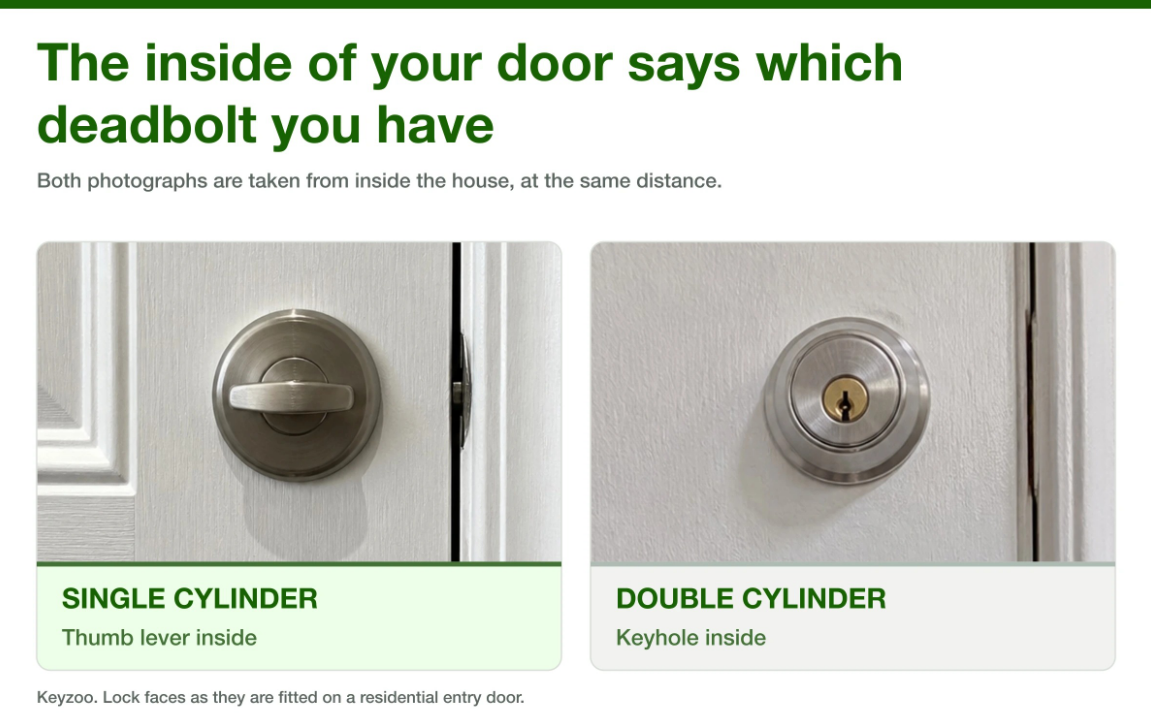
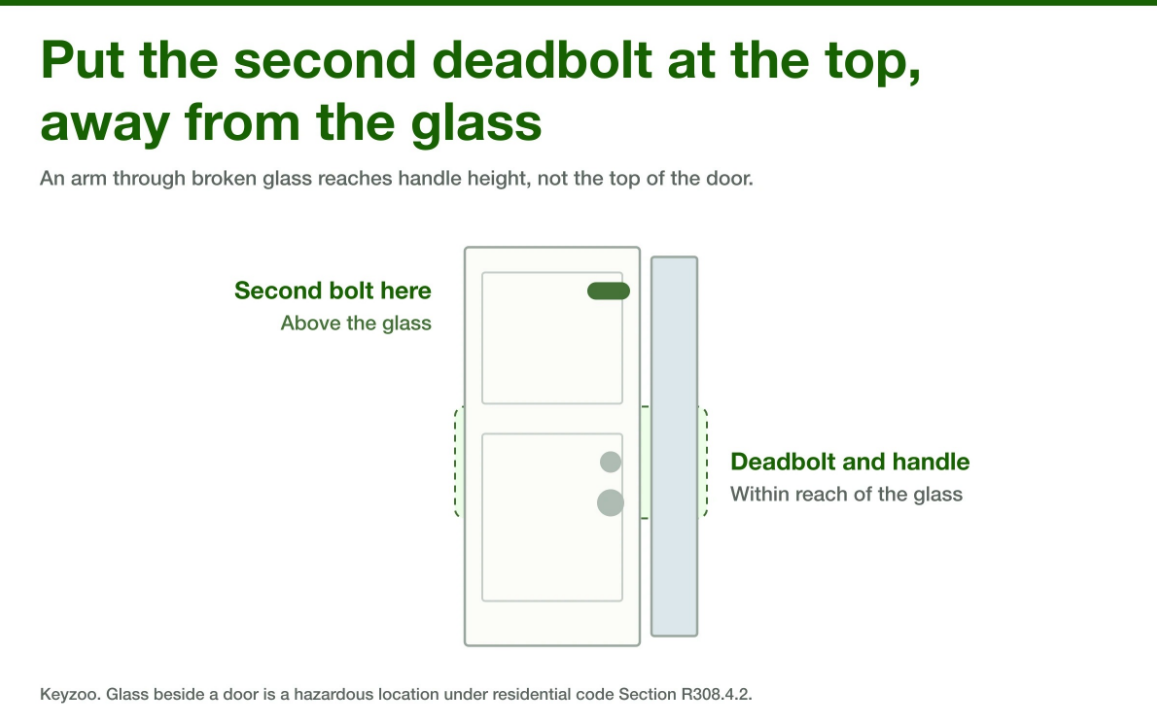
You are picking a deadbolt for your front door, or you have just moved into a house that came with one, and there are two kinds to choose between. They cost about the same, so money is not what is stopping you. Single cylinder vs double cylinder deadbolt comes down to one thing: whether there is a keyhole on the inside of your door. Look above your door handle. The square metal bolt that slides out into the frame when you turn the lock is the deadbolt. A single cylinder has a keyhole on the street side and a small lever on the inside that you turn with your thumb. A double cylinder has a keyhole on both sides, so the key gets you out as well as in. What you want to know is whether that second keyhole makes your house safer, whether you are allowed to put one on your front door at all, and what to do about the glass panel beside it. The glass is usually what sends people looking at double cylinder deadbolts, and the deciding factor turns out not to be security. It is which of your doors the building code treats as your way out of the house. By the end you will know which deadbolt is on your door right now, what the code says about a key on the inside, where a double cylinder is still fine, and what I do instead when there is glass beside a front door. I am Eli Itzhaki, and I have been taking these locks off doors and putting them back on for more than 25 years. You can tell a single cylinder deadbolt from a double cylinder deadbolt by standing inside the house and looking at the lock above the handle. It takes about ten seconds. The glass panel beside your front door already had to be safety glass, but builders almost always use tempered, which breaks into pieces and leaves an opening. Laminated is the kind that stays in its frame. Swapping a double cylinder deadbolt for a single cylinder one uses the two holes already drilled in your door, so it is a hardware change rather than carpentry. Residential deadbolts are not graded on one number. The Builders Hardware Manufacturers Association rates them separately for security, durability and finish, so a lock can be strong and still have a cheap coating. Put a single cylinder deadbolt on the door you would run out of in a fire, and save the double cylinder for a door that is not your way out. Your front door is the one the code was written about, and it has to open from the inside with no key in your hand. The second keyhole solves exactly one problem, which is a glass panel beside the door that somebody can break and reach through to turn the lever. A shop or office front door is the place a double cylinder is still allowed, because the fire code gives businesses a written exception for it. Where that comes from: the residential code most states build from says your exit door has to open from the inside with no key. I have also taken more double cylinder deadbolts off front doors than I have ever installed. What you are comparing Single cylinder deadbolt Double cylinder deadbolt This takes about ten seconds and you can do it before you buy anything. Go inside, shut the front door, and look at the lock above the handle. A small flat lever, usually an inch or so long, sitting in a round or rectangular plate, means you have a single cylinder deadbolt. Turn it with your thumb and the bolt moves. A keyhole instead, the same shape as the one on the street side, means you have a double cylinder deadbolt, and that bolt will not move for anything but a key. Two things look like a third option and are not. A keypad or smart deadbolt almost always has a thumb lever on the inside plate, so it counts as a single cylinder. And a lever with a small screw or pin through it is a single cylinder with a removable thumb turn, which becomes a double cylinder the moment somebody pulls the lever off. The product names are a mess, which is worth knowing before you shop. A deadbolt keyed on both sides is sold as a double cylinder deadbolt, a double keyed deadbolt, a double sided deadbolt, or a deadbolt with a key on both sides. Those are all one lock. The other one gets called a thumb turn deadbolt, and there are really only those two types of deadbolts on a front door. Which deadbolt you have is decided by the inside face of the door. Fire Prevention Week runs October 4 to 10 this year, and every home escape plan it asks families to practice assumes the front door opens when somebody pushes on it. The code backs that assumption up with a rule, and the rule is attached to one door in your house. Here is what it asks that door to do. The bolt has to come back out of the frame when a person inside reaches for it. No key, nothing to remember, nothing to work out. The code's own wording is that the exit door "shall be readily openable from the side from which egress is to be made without the use of a key or special knowledge or effort." Egress is the code's word for getting out. The North Carolina Office of State Fire Marshal quoted that sentence in an October 2023 ruling on Section R311.2. A key on the inside fails all three of those at once. It is a key, you have to know where it is, and getting it takes effort. That is why a double cylinder deadbolt does not belong on the door you would use to leave, and it is the part the product listings never mention. One caution, because this ends in a local decision. States and cities amend the code they adopt, and some are stricter than the version quoted above about the other exterior doors on a house. Your building department will tell you in one call which of your doors it counts. Businesses are the real home of this lock, and the fire code says so in writing. A store, an office, a warehouse or a place of worship is allowed a key-operated lock on the inside of its main exterior door, provided two things are true. The lock has to be obviously locked when it is locked. A durable sign also has to be posted beside the door reading "This door to remain unlocked when this space is occupied", in letters an inch high on a contrasting background. Los Angeles County publishes that requirement word for word for the people reviewing building plans, and notes that a building official can take the permission away for a specific door. Around a house, the softer case is a door that is not your exit door: a garage-to-house door, a basement door, a door into a shed. When somebody calls me about a sidelight, which is the long thin window beside a front door, they have usually decided already that they want a key on both sides. Here are the three things I do instead, in the order I suggest them. Change the glass, not the lock. That panel is already safety glass, because the residential code counts any glazing within 24 inches of a door, with its bottom edge under 60 inches off the floor, as a hazardous location. Boulder County publishes that rule out of Section R308.4.2. Tempered and laminated both satisfy it, and builders pick tempered because it is cheaper, which is the kind that falls out of the frame in pieces. Laminated glass holds a plastic layer between two sheets, so a broken panel stays where it is. A security film over the glass you already have does a weaker version of the same job for much less money. Add a second bolt up high. A surface bolt or a second deadbolt near the top of the door puts one of your two locks out of reach of the broken panel. Your exit door still opens from the inside without a key, because both of them turn by hand. Do not hang a key beside the door. This is the advice I see most and it is the worst of the three. A key on a hook, or left sitting in the inside cylinder, goes straight to whoever reached through the glass. The second keyhole then protects nothing, and you have made the door harder to get out of for no gain. Where the second bolt goes on a door with glass beside it. If the lock on your exit door has to change, the good news is in the door prep. Schlage's own installation sheet covers its single cylinder and double cylinder deadbolts in one document, on the same 2-3/8 inch or 2-3/4 inch backset and the same 1-3/8 inch to 1-3/4 inch door thickness. The holes are already in your door, which makes this a lock change rather than a door change. While you are choosing the replacement, look for the Builders Hardware Manufacturers Association label, which rates a residential deadbolt separately for security, durability and finish. Here is what we do on a deadbolt swap, and what you get out of each part of it: We work out which of your doors the code treats as your exit door before anything gets unscrewed, so you are not choosing a lock off a product page. We fit the new deadbolt into the holes already there, and check the strike plate in the frame while we are in it, so the bolt stops catching on the way in. We cut the new lock to the house key you already carry, so you are not adding a key to your ring. Keyzoo runs 24/7 mobile locksmiths and self-service key kiosks in 11 states. A deadbolt change is one of the jobs we do most on residential doors. Is a double cylinder deadbolt harder to pick than a single cylinder one? No. Picking happens from the outside, and the outside cylinder on the two locks is the same part. The second keyway faces the inside of your house, where nobody is standing with a pick. Will a double cylinder deadbolt stop a small child from opening the front door? It will, and that is a real reason people buy one. It also means an adult has to find a key to get out, which is the whole problem with it. A latch mounted high on the door, or a chime that sounds when the door opens, does the child-safety job without blocking the way out. Can I leave the key sitting in the inside keyhole? You can, and people do, but it cancels the only thing the lock was bought for. A key left in the inside cylinder is within reach of the same broken panel the second keyhole was supposed to defeat. Does anybody inspect a deadbolt after the house is built? No, and that is why locks the code does not allow stay on doors for decades. An inspector signs off on a finished door once. The rule still applies to your door every day afterward, and so does the fire it was written for. A locksmith can tell you in one visit which of your doors the code treats as your way out, and change the lock on it the same day. Book Now and a Keyzoo tech will come to you.Key takeaways
Single cylinder vs double cylinder deadbolt: the short answer
Which one is on your door right now
What the code says about a key on the inside of your door
Where a double cylinder deadbolt is still fine
Glass beside your door: what I do instead of a second keyhole
Swapping a double cylinder deadbolt out, and what it takes
Frequently asked questions
Not sure which deadbolt your exit door is allowed to have?